
But now, the Swedish Trade Union Confederation (LO) demands making reduced working hours part of the next round of central negotiations. Employers firmly reject this demand.
Read this article in Swedish on Arbeidsliv i Norden
In Sweden, the working hour issue has largely been dormant since the 1970s. Since the working week was reduced from 70 hours in the late 1800s to 40 hours in 1973, the 40-hour week has been the norm, although the actual number of hours vary between sectors and trade unions.
Meanwhile, the working hours debate has continued in other countries and since the 1990s it has, for instance, been 37.5 hours in Norway, 37 hours in Denmark and 35 hours in Germany.
Different drivers behind countries’ reduced hours
When the demand for reduced working hours began to emerge in parts of the Swedish trade union movement, the two labour market reporters Ana Danielsson Öberg and Tommy Öberg became curious.
Which drivers had made the other countries shorten the working week as early as in the 1990s? And what had those processes been?
Both reporters set out to find answers. The result was the report “The never-ending fight for time. Role models and inspiration from abroad”, which was recently presented at a fully booked breakfast seminar organised by the publisher Arena Idé.
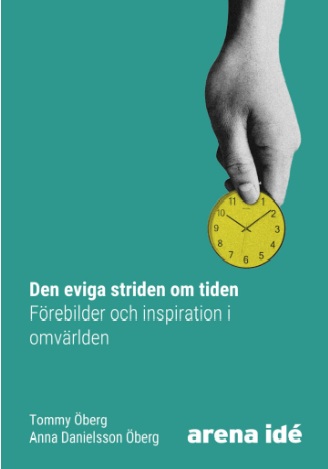
The seminar was in itself an example of how the issue of reduced working hours had awoken from its Sleeping Beauty-like slumber. Around 100 people turned up and a bigger venue had to be found quickly.
Anna Danielsson Öberg and Tommy Öberg expected to find similar stories about the drivers for reduced working hours, but they were clearly mistaken. In Norway, shorter hours were an issue of fairness.
In Denmark, they were part of a crisis package and in Germany reduced working hours became an important argument for creating more jobs.
Yet regardless of the drivers, all three countries had one thing in common. The issue of shorter working hours has led to conflict, resulting in both strike action and lockouts. It has taken strong trade union pressure and powerful motivations to achieve the cuts.
A moral demand for justice
In Norway, the demand for a 6-hour day emerged as early is in the 1980s, driven by several LO unions that were critical to the fact that civil servants had a 37.5 hour working week while workers had 40.
Correcting this injustice was considered both necessary and a moral demand.
The Norwegian Confederation of Trade Unions believed the demand went too far and wanted working time reductions to be handled in sector-specific negotiations, while employers preferred to settle the issue centrally.
The disagreement led to a lockout of 100,000 workers, but little by little, the employers’ side gave in and working hours were reduced to the desired 37.5 hours.
Around the same time, Norwegians were also given longer holidays. Yet inequalities in working hours remain an issue in other ways.
Around the millennium, the Norwegian Nurses Organisation demanded that disparities between shift workers in industry and healthcare should be addressed.
Healthcare workers with the same level of shift work as industry workers were not compensated with equally reduced working hours. Nurses have since been compensated, but healthcare workers in the municipal sector have not.
“While the system has changed, it has not changed as much as desired and there are still calls for further adjustments. However, our impression after conducting interviews in Norway is that the issue of working time reduction is effectively dead,” say the report’s authors.
A conflict-ridden journey towards shorter hours
In Denmark, the drivers and approaches were different. The 1980s in Denmark have been known as “the poor 1980s”. The country faced an economic crisis with high inflation, weak public finances and high unemployment.
The social partners often struggled to agree, and the centre-right government coalition wanted a calmer labour market. Inflation would be curbed through lower wage growth and public service cuts – measures that would worsen workers’ conditions.
Industry employers wanted to halve the wage growth rate and since LO already had brought up the issue of a shorter working week, inspired by Germany, they demanded a 35-hour week without any reduction in pay.
One of the key arguments was that a general reduction in working hours would reduce unemployment by creating more jobs.
Another argument was that workers would gain more leisure time. Employers said no, and in 1985, around 300,000 workers went on strike, protesting against both employers and the government.
After many rounds of failed mediation attempts, draft legislation and wildcat strikes, the centre-right government pushed through a bill reducing working hours by one hour per week alongside lower wage growth.
The government was criticised for interfering in an issue meant to be handled by the social partners, but the year after, the working week was reduced to 37.5 hours and today it is 37.
To offset wage growth, part of the room for pay rises was redirected into pension contributions in a tripartite agreement known as “Fælleserklæringen” (the joint declaration).
One element of working time arrangements in the Danish labour market is “fritvalgskontoer” – or free choice accounts. They are praised for providing flexibility for individuals and involve setting aside part of the scope for pay rises in a personal account.
Today, this corresponds to roughly one month’s salary and can be used by the individual for additional leave, shorter working hours or extra payments. The account is reset once a year.
German hours determined by boom and bust
There is still a hot debate about working hours in Germany. Back in the late 1970s, IG Metall demanded a shorter working week, where one important argument was to create more jobs. In 1984, the issue came to a head.
First, IG Metall staged a seven-week long strike. Employers answered with a lockout of 600,000 workers and the battle over working hours turned into one of the biggest labour market conflicts in Germany since WWII.
Little by little, the employers gave in and the process leading to a 35-hour week began in 1984. But it did not cover everyone. The 35-hour week does not apply to all sectors and not even all of IG Metall’s members.
In former East Germany, many industry workers still work two to three hours more per week and attempts to reduce the differences have proven difficult.
Today’s German employers are more interested in flexibility, being able to adjust working hours, than straight forward working hour reductions.
A matter of fairness for LO, employers fear labour shortages
Swedish LO that has recently revived the issue of reducing working hours. The message is clear.
LO wants to push for shorter working hours to achieve a 35-hour working week as part of the 2027 round of central collective bargaining – covering all thirteen of its affiliated unions.
“Our Nordic neighbours have it, and parts of Europe, including Germany, have it. We want to move towards a more European level,” said LO’s Head of Negotiations, Veli-Pekka Säikkälä.
He participated in a panel debate following the report’s authors’ description of the changing working hours in Germany and the Nordic neighbours.
Also present were the players who will have decisive influence over where the demand for a general reduction of working hours ultimately lands. In addition to LO’s negotiations secretary Veli Pekka Säikkälä, participants included Mattias Dahl, the deputy CEO of the Confederation of Swedish Enterprise, Malin Ragnegård, President of Kommunal, Jeanette Hedberg, head of negotiations at the Swedish Association of Local Authorities and Regions, and Martin Wästfält, head of negotiations at Unionen.
Veli Pekka Säikkälä also argues that the demand reflects LO’s ambition to pursue a forward-looking working time policy based on solidarity.
The issue is being pushed at central level to ensure that working hours are the same for everyone, reducing disparities with more industry-heavy unions, where many employees already work shorter hours.
The panel debate shows without a doubt that employers and employees have differing views on the demand for a general reduction in working hours, and on where the issue should be negotiated.
LO and the Confederation of Swedish Enterprise agree on one point, however: Working hours is a matter for negotiations between the social partners, not for legislation or political intervention.
Beyond that, their views on a general reduction in working hours diverge significantly.
The Confederation of Swedish Enterprise has firmly rejected the idea of making working hours part of the central negotiations, and this position has now been formally adopted.
A general reduction in working hours would be too costly, they argue. There is already a shortage of labour in many sectors, and shorter working hours would only exacerbate this.
They also place little weight on comparisons with other Nordic countries. Based on annual working time rather than weekly hours, Swedes work more or less the same number of hours as their Nordic neighbours, depending on political decisions such as parental leave.
They also question whether reducing working hours is the right thing to do in an increasingly uncertain global environment.
For the Kommunal trade union, fewer working hours remains a central theme. Their assistant nurses have the highest sickness absence out of any sector, and 42,000 of them leave their jobs every year because they can no longer cope.
That is why Kommunal’s president considers a reduction in working hours to be a prerequisite for the future of the welfare state.
However, Jeanette Hedberg, head of negotiations at the Swedish Association of Local Authorities and Regions, disagrees.
She believes a reduction in working hours would result in the loss of millions of working hours, at a time when there is already severe staff shortages.
“The issue is being raised at the worst possible time,” she says.
Unionen trade union is also critical. It represents many white-collar industry workers and wants to safeguard the so-called “mark” – the benchmark rate of pay increases negotiated between the social partners in the industrial sector at branch level.
According to Martin Wästfelt from Unionen, this is also where negotiations on working time should take place.
For a long time, sectoral agreements within industry have already delivered reductions in working hours, and Unionen continues to pursue a gradual reduction in working time for its members.
So the question is what will happen in the 2027 round of collective bargaining? Will Swedish workers get the same working week as neighbouring countries have had for nearly 40 years?
What Anna Danielsson Öberg and Tommy Öberg found when looking for the drivers and implementation of working time reductions is that “a strong trade union mobilisation, firmly anchored among members, is required to push the issue high up the agenda. Otherwise, it will be difficult.”