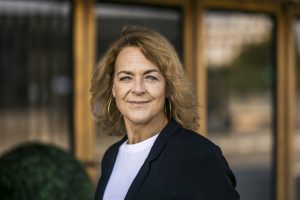
Sigrún Gunnarsdóttir, professor at the University of Iceland and the main professional advisor of the project. She says that in 2023 the then labour minister, Guðmundur Ingi Guðbrandsson, wanted to react to a survey on the facilities and wellbeing of employees.
Read this article in Norwegian on Arbeidsliv i Norden
That survey indicated that two working groups stood out in a negative way – employees in schools and in health care.
“The decision was to start with the schools,” she says.
AOSH was assigned the project and provided with state funding, with the primary aim of strengthening workplace culture in kindergartens and primary schools.
Schools were invited to participate, and five were chosen: three kindergartens and two primary schools. Gunnarsdóttir was appointed as the project’s lead adviser.
She and AOSH staff members maintained close communication with the schools’ principals, offering guidance on the most effective ways to achieve the project’s goals.
“This included many practical actions and interventions. For instance, we prepared a specialised training package that was put online for staff to read and use for their benefit, and we helped the schools prioritise what to focus on.”
In line with employees’ views
Gunnarsdóttir says the main emphasis was to activate the employees to participate, to empower them and to make the management supportive.
“We used a special model to create success and wellbeing among employees based on current scientific knowledge.
“The most important thing is that it has to be absolutely clear who is doing what, and that employees get support to do what is expected of them with autonomy and flexibility.”
What was actually done varied between schools. The culture, facilities, combination of employees and other things differed. Gunnarsdóttir says the school leaders along with their staff assessed for themselves where action was needed.
“They were assisted by other employees on all kinds of workdays. The purpose was to avoid doing projects that would burden people and then it would just be over and only create disturbance.
“We did everything very carefully in order to avoid falling into that trap. We always did everything in accordance with what the employees thought was important to spend their energy on.
“We did a big survey at the start to evaluate what we should work with and then each school took their various routes.”
Communication key
However, all of the schools had one thing in common; emphasis on communication.
“Most of them either made a communication pact or renewed a previous one. Many schools also worked on teamwork and team training.
“And a lot of work was also put into making sure that everybody knew their role in the workplace, and discussing that role in order to work on the shared goal of creating a good job culture allowing everyone to feel good. The children would benefit from that,” Gunnarsdóttir says.
Afterwards, the success of the project was evaluated, for example by interviewing the school leaders and staff at each school.
“The biggest change by far was in communication. Everybody communicated carefully, worked on a communication pact together, went through it and decided what it should contain and how to implement it.
“In one of the kindergartens, each division discussed how to implement a certain theme into that pact, like respect, trust and so on. This was all done on the people’s basis.”
According to Gunnarsdóttir, all this resulted in an important change in most of the schools.
“For example, there was a difficult and heavy atmosphere in one of them. The communication was not good, there was a lack of trust and psychological safety.
“They worked purposefully to change this, discussed it and tried different things to improve it. And the atmosphere changed dramatically. Even the children’s parents felt it.”
Empower the school leaders
Gunnarsdóttir says workplace culture is a word that can be used for communication, basic rules and values.
“Communication has to reflect that ‘I respect what you do and you respect what I do’. We are responsible for our work, and then of course we also cooperate.
“In this case the changes in communication reflected the change in that atmosphere. Everything became much clearer. AOSH asked me to use a basic model that I’ve used previously for a long time. And that worked out well.”
Employees also felt less stressed after that change, which is another effect from the different atmosphere. Because of that project’s success, the model is now being used in other schools.
Gunnarsdóttir says the basis of it is empowerment.
“My role was to empower the school leaders, they had to empower their employees, and the employees empowered the children. And I had to show them how to do that. You have to listen, have sufficient demands and be clear on the framework we work in.”
This has also been introduced among AOSH’s sister institutions in the Nordic countries and the Danish one said this is an unusual way to do things.
“We focused on seeing the opportunities to strengthen the support, communication and so on. We can’t change everything about the children’s behaviour or facilities but we can strengthen everything else without much problem.”
Now, this work has already started in other types of workplaces.
“We are taking similar projects to health care institutions. That will be on the same basis but the implementation will be totally different.
“It’s very different working with a handful of school leaders compared to tens of hospital directors and a few thousand employees in the biggest hospital.
“But like in the school, we will base everything on what researchers say works. It really is not that complicated, but the main challenge is to make people want to put the knowledge into practice.”