“It was a huge dopamine kick for my neurodivergent brain. Afterwards, everything in me was screaming: Again. Again. Again! When can I do it again?”
Read this article in Danish on Arbeidsliv i Norden
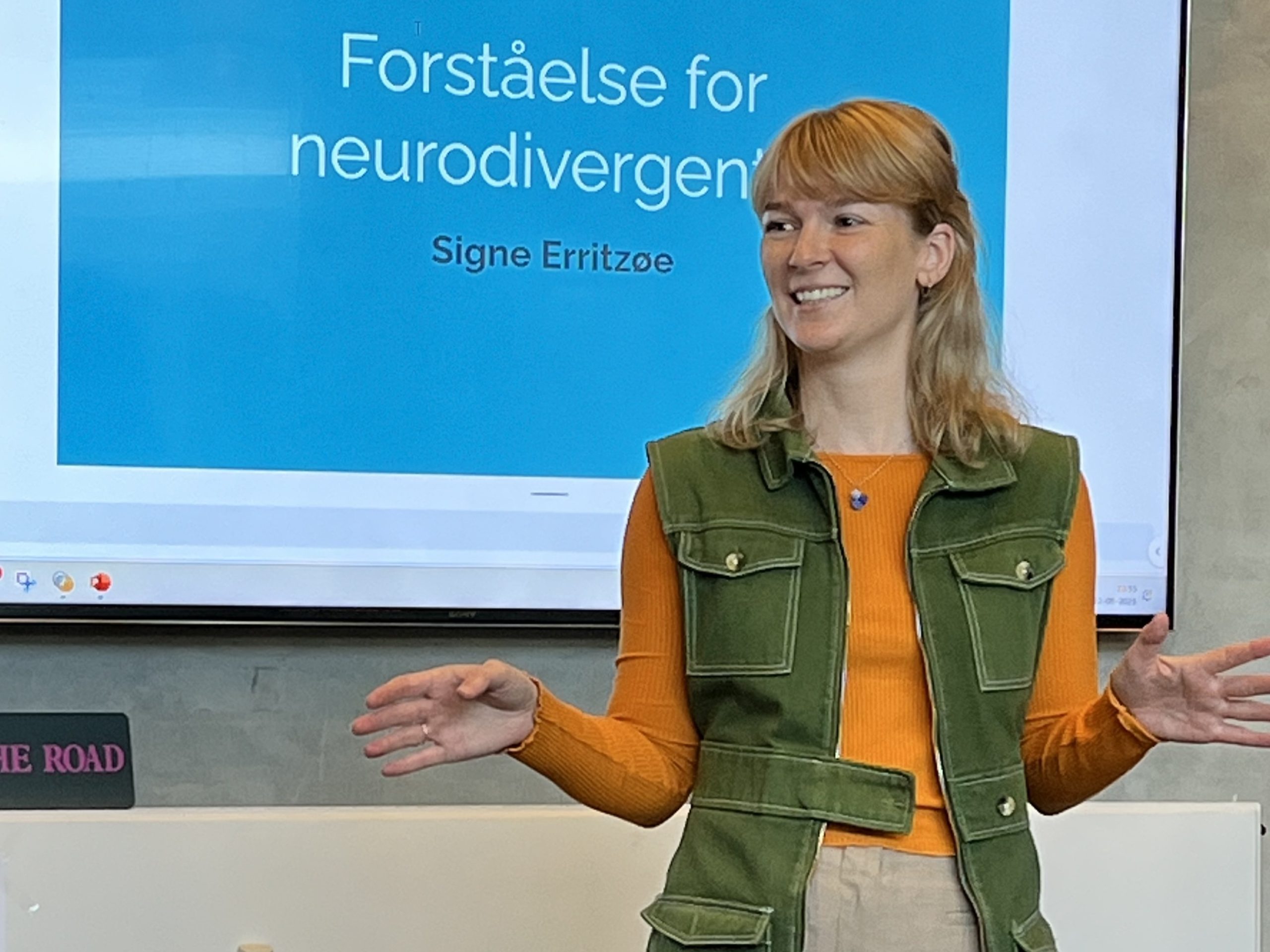
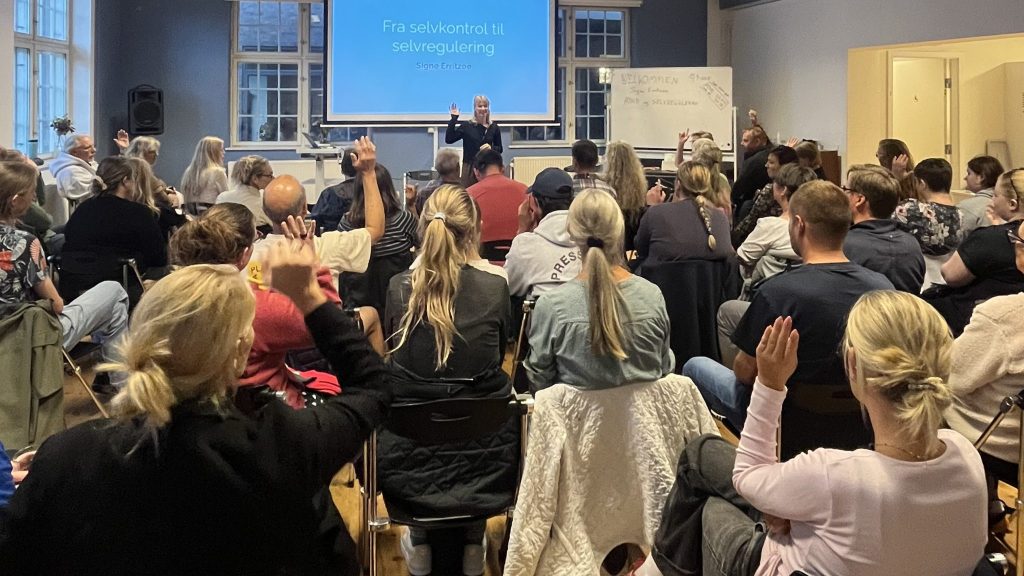
This is how Signe Erritzøe describes what she felt like after giving a talk to managers and employees at one of Denmark’s major consultancy firms, Implement Consulting Group.
More about Signe Erritzøe
Coach, author, public speaker, runs online work and movement communities for neurodivergent people.
Website: https://neurodivers-ledelse.dk/
The company wanted to offer a good work environment for their staff with neurodivergence – ADHD and autism – and booked a talk with Signe Erritzøe. She has written several books on good work environments for neurodivergent people and runs her own business coaching neurodivergent people.
My preferred drug
Signe Erritzøe also offers talks on methods helping people create a good working life with ADHD, including ways to regulate dopamine. This is something many people with ADHD struggle to do.
She also uses these methods herself. Nevertheless, her talk at the consultancy firm triggered a big dopamine boost in her brain, she explains.
“The following night I lay awake for hours wondering how I could get my hands on more dopamine. My brain’s ‘preferred drug’.”
This experience is a very good illustration of what people with ADHD are facing, says Signe Erritzøe.
“We are driven by impulses towards the kind of intense dopamine rewards that was triggered in my brain by giving a successful talk. It feels like a pleasant high and it awoke my old friend ‘workaholism’.”
Through her work, she meets many people with ADHD who are also workaholics. For many years, she was one too – until she learned to understand her own ADHD and gradually developed the methods she is now teaching and practicing.
This has given her a much better private and working life, she feels.
Hyper focus comes at a high cost
Dopamine is a neurotransmitter which plays a central role in the brain’s reward system. It helps people pursue goals by awarding certain behaviours, which in turn makes us motivated to repeat them.
But the dopamine system is out of balance in many people who have ADHS, explained Signe Erritzøe.
“This dysregulation affects my ability to feel motivated and engaged in long-term tasks when rewards do not come quickly. As a result, for much of my working life I have been driven towards jobs and tasks that offer instant reward.”
But the price for the dopamine hunt and hyper focus is high. That is something Signe Erritzøe has learned from her own experience and from her many conversations with others who have ADHD.
The dysregulation also means that most people with ADHD struggle to regulate their attention.
They might experience an excess of attention – often called “a superpower” or “hyper focus”, which might make them extremely engaged when a task feels interesting and important to them.
“Many employees with ADHD work in ways that do not take their physiological needs into account. They forget to eat and drink during working hours and come home drained of energy.”
As a result, they often lack the energy to spend time with their families and on leisure activities.
“Their partner often does everything at home, or they haven’t even had the time or energy to start a family,” she says.
From big to small dopamine kicks
Dysregulated and high dopamine levels also mean that activities that do not release a lot of dopamine can seem boring, says Signe Erritzøe.
“Solving a mundane task at work, taking a stroll in nature or spending a quiet Sunday with a partner does not give a high enough dopamine kick for the neurodivergent brain to find it motivating in a way that creates the desire to repeat it. The dopamine release is simply too small.”
That is why it is important to gradually reduce the large dopamine kicks. And just like coming off any drug, like cocaine, this is hard.
“It is very uncomfortable to come out of the dopamine rush and state of intense concentration. I become restless and almost a little irritated or depressed. But now I know this and remind myself that the feeling will pass when I stick to small dopamine rewards,” she says.
For Signe Erritzøe it helps to get out of her head and into her body: dance, listen to music or do something creative.
Remaining high on dopamine creates a vicious cycle.
“At some point, people around you start to complain and many people with ADHD already use a lot of energy navigating work and private life in ways that lets them avoid facing criticism from those around them,” she says.
If, on top of all this, there are conflicts with others, it drains even more energy. As a result, many people with ADHD have experienced breakdowns and going off sick.
A dopamine-driven labour market
It is hard having ADHD in today’s labour market, says Signe Erritzøe with a sigh. In her experience, society in general and many workplaces are extremely performance driven.
This is challenging for everyone, but in particular for people with ADHD who are drawn towards achievements and find it difficult to listen to their bodies and find their own limits.
“This is something the labour market and employers must understand and adjust to so that employees in general can thrive and benefit from the many skills people with ADHD can offer,” says Signe Erritzøe.
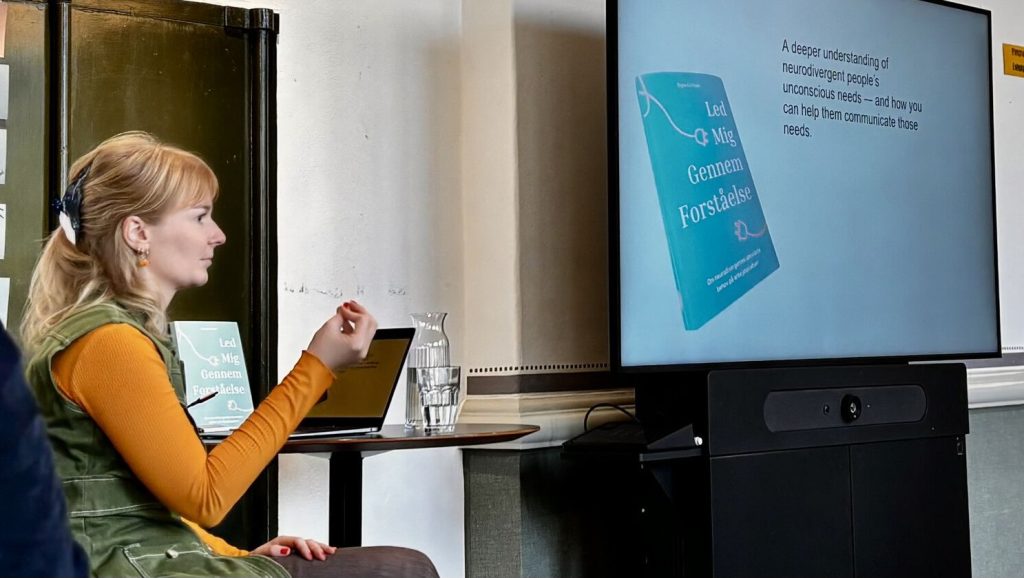
Her latest book is called “Lead me through understanding. On the unconscious needs of neurodivergent people in the workplace”. In the book, she shares insight on effective ways to lead employees with ADHD.
One key advice in the book is to create conditions in the workplace that allow employees with ADHD to run a community with others who have the condition. In this way, they can support each other in training their brains to maintain a more stable supply of dopamine without large fluctuations.
The 45/15 method
For this purpose, Signe Erritzøe has developed the “45/15-method”: Work for 45 minutes and then take a break for 15 minutes. Preferably, those 15 minutes should be spent doing some physical activity.
“Asking a person with ADHD to take a break from work after just 45 minutes can almost feel unnatural, and the brain wants to return to the task quickly – not wait 15 minutes. But the break is necessary to help prevent large dopamine spikes.”
Leaders need to know more
Neurodivergent people have strong skills in areas that could be among the most sought-after by 2030 – especially within AI. Yet only 25 per cent of neurodivergent people feel included in the workplace.
This is according to a global study which also points out that these skills are especially brought into play when the neurodivergent workers experience inclusion at work.
According to the report, neurodivergent employees score high on skills in AI, data analysis, cyber security and creativity. These are all areas that the World Economic Forum Future of Jobs 2025 lists as being in demand in the coming years.
The most important factors for inclusion of neurodivergent employees are how much psychological safety they experience and how leaders behave.
The study also suggests that a lack of inclusion leads to widespread dissatisfaction. 39 per cent of neurodivergent respondents plan to leave their job within the next year.
The study is based on a global survey of 2,000 working respondents in 22 countries, including Denmark and other Nordic countries. It is presented in the report “Neurological Inclusion in the Workplace,” published by the audit firm EY and consultancy firm Cocuura.
“Although neurodiversity is being discussed more these days, helping more people to disclose their diagnoses at work, there is still generally a sense of reluctance in Danish companies, both among employees and management.
“We lack knowledge, and many unfamiliar and uncomfortable situations do occur,” says Lena Boel, co-founder of Cocuura.
In a press release about the study she adds:
“There are so many benefits to talking about how the potential of neurodivergent employees can be unlocked through a safer environment.
“At the same time, it is also important to speak openly and honestly about how other employees, management and workflows are affected.”
So Signe Erritzøe helps workplaces create an environment that supports this type of working community, including the use of the 45/15 method. She uses the method herself in the shared online office she runs for neurodivergent people.
“Being part of a community is key to maintaining the breaks. You need a person to keep track of the time and call for breaks. If not, workers with ADHD become so engrossed that they forget to take a break. Some might even forget to go to the toilet or eat.”
Body and community
At this point, her interview with the Nordic Labour Journal has lasted for about an hour, and the reporter asks Signe Erritzøe whether it perhaps is time to take a break – if we are to follow her own advice. So we do.
When we start the interview again after 15 minutes, she explains:
“This is a great example of the challenges we who have ADHD are facing, and that a model like 45/15 is good as long as it exists in a framework in the office.
“When you proposed a break, I felt like skipping it and carry on talking. Because when we talk about ourselves, we experience a large release of dopamine.”
What happened instead was that Signe Erritzøe spent the 15 minutes to lie in her garden listening to calm music and breathing slowly and deeply.
She spends other workday breaks dancing, and she has created a small online movement community for neurodivergent women where participants help each other move their bodies.
“Taking breaks from tasks and moving your body during the working day in a community is extremely important for us neurodivergent people – and also for a healthy working life for everyone else in the workplace.”