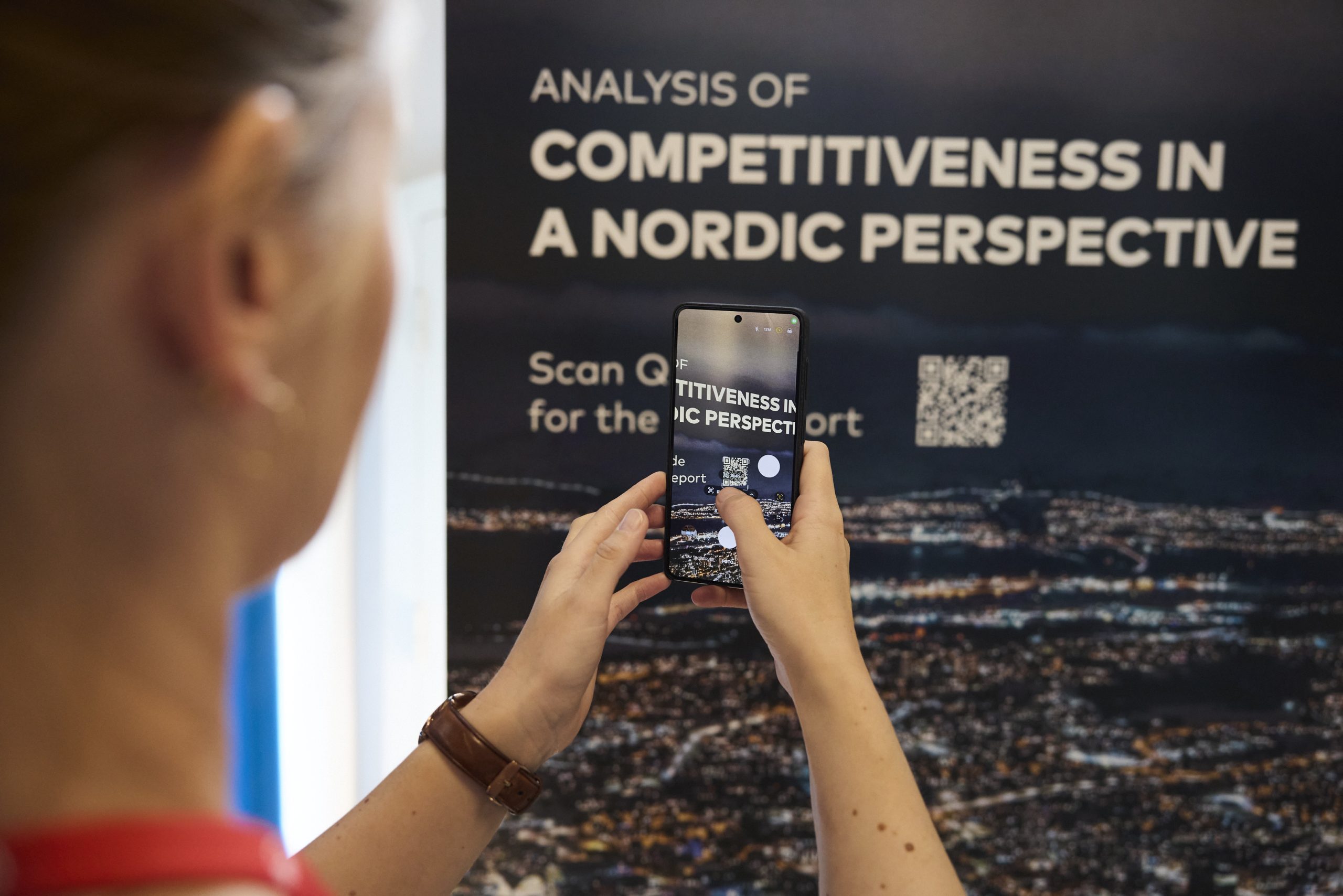
Copenhagen Economics has made a “Nordic Draghi report” on commission from the Nordic Council of Ministers. The analysis was presented to the Nordic ministers for co-operation (MR-SAM) and business (MR-N) when they met in Copenhagen in late September this year.
Read this article in Norwegian on Arbeidsliv i Norden
Analysis of Competitiveness in a Nordic Perspective
Carried out by Copenhagen Economics for the Nordic Council of Ministers
The commission was to analyse central drivers, challenges and opportunities for Nordic competitiveness.
The analysis covers areas such as innovation, entrepreneurship, access to capital, digitalisation, regulation and economic resilience.
There report consists of two parts:
- An analysis of the factors behind historical Nordic competitiveness and challenges linked to that.
- A structured international benchmarking exercise across eight dimensions: innovation capacity, entrepreneurship and business dynamism, access to capital, digitalisation, administrative and regulatory burdens, energy costs and the green transition, economic resilience, and Nordic market integration.
The report concludes that the Nordic region remains strong but that the Nordic countries must take action to maintain their competitiveness.
The report does indeed establish that the Nordic region is one of the most competitive in the world. But its lead is narrowing: Since 2000, productivity has increased by 25 per cent in the Nordic region, compared to 43 per cent in the USA.
Main results
The report concludes that the Nordic region has:
- High productivity: Productivity levels in the Nordic region are 24 per cent above the EU average.
- Strong institutions: High levels of trust, low inequality, generally high levels of education and high labour market participation (particularly among women) are highlighted as distinctive competitive advantages.
- Green transition: The region has successfully combined economic growth with ambitious climate policies.
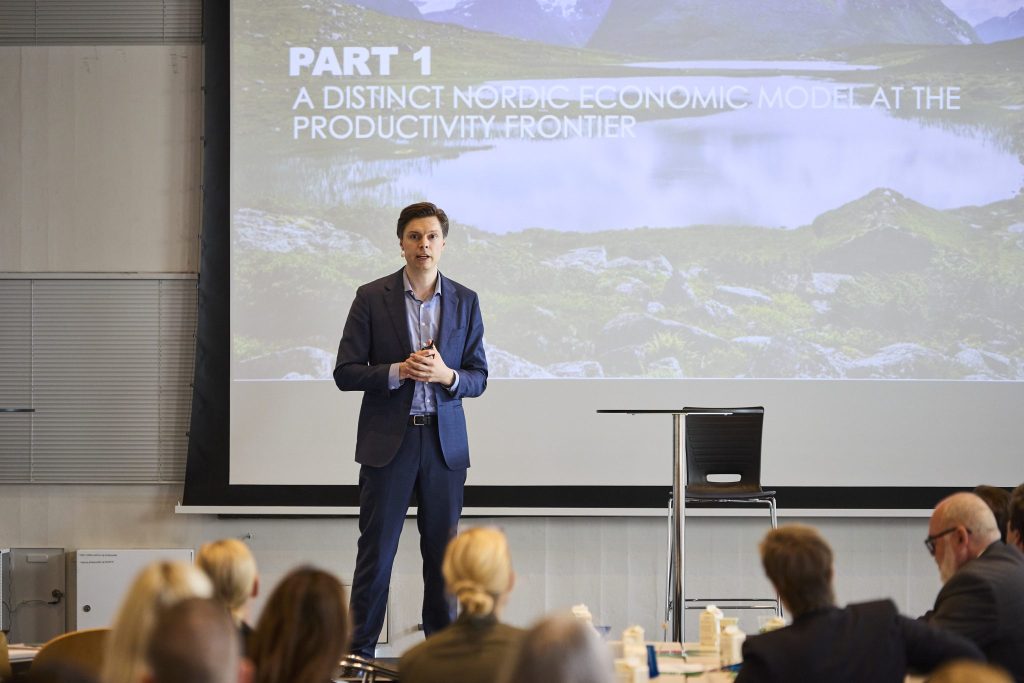
Despite this, however, the analysis points out some existing challenges. The Nordic competitive advantage is gradually being eroded, particularly by the United States:
- Slower productivity growth than the US: Since 2000, productivity in the Nordic region has increased by 25 per cent, compared with 43 per cent in the US.
- Challenges in scaling firms globally: The Nordic countries perform well in innovation and start-up creation but struggle to scale businesses into global leaders. For example, the region has only half as many unicorns – start-ups valued at more than USD 1 billion – per capita as the US.
- Ageing corporate landscape: The median age of the 15 largest companies in the Nordic region is 120 years, compared with 50 years in the US and just 30 years in China.
- Shortage of venture capital: Venture capital investment accounts for around 0.11 per cent of GDP in the Nordic region, compared with 0.91 per cent in the US.
New report: Gender equality is key to Nordic competitiveness
The report How can Nordic competitiveness benefit from gender equality? from Nordic Information on Gender (NIKK) looks at how gender equality impacts Nordic competitiveness.
The report was written on commission from the Nordic Council of Ministers.
The report shows that gender inequality can lead to the inefficient use of skills and resources in the economy, with implications for productivity, innovation and the labour market.
This is particularly relevant as the Nordic region faces labour shortages and major changes driven by the digital and green transitions.
Women remain underrepresented in technology and AI-related fields. The report highlights the risk that AI systems trained on historical data reflecting existing inequalities may reproduce these patterns in recruitment, resource allocation and innovation.
The green transition also requires a broad range of skills and perspectives. The report highlights research that shows how organisations with a more balanced gender representation in leadership positions are more likely to incorporate long-term perspectives and sustainability considerations into strategic decision-making.
Nordic alliance for growth
At the September meeting, the Nordic ministers for cooperation (MR-SAM) and business (MR-N) agreed to enter into a Nordic alliance for growth to secure Nordic competitiveness going forward.
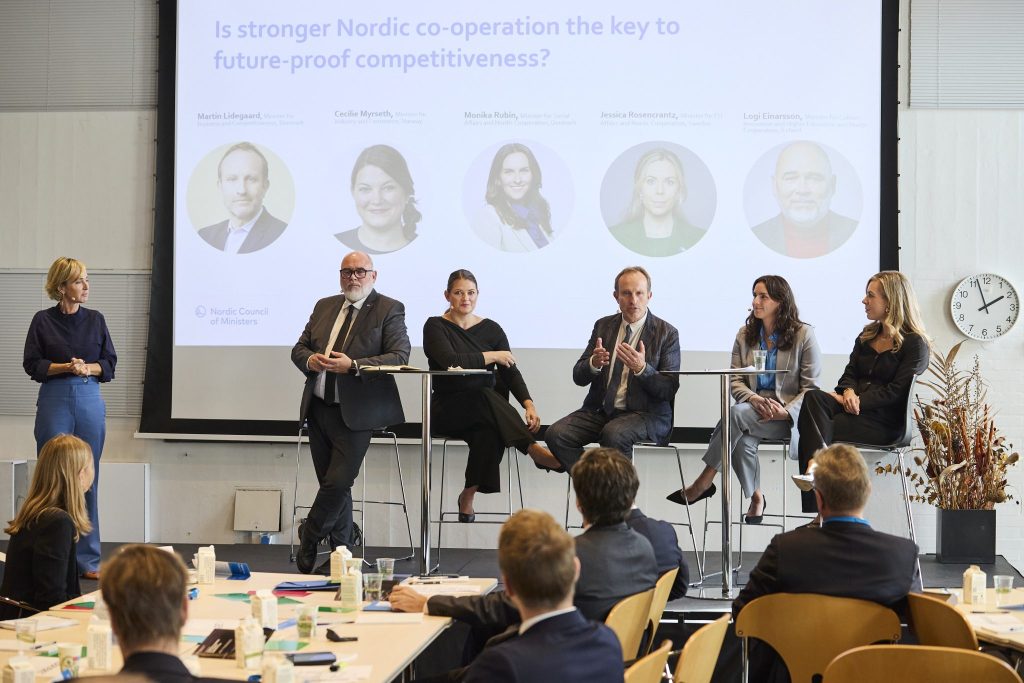
In a joint declaration, the Nordic countries stated their intention to explore opportunities for developing joint initiatives to:
- Strengthen access to risk capital for Nordic businesses
- Promote Nordic companies’ position in emerging technologies
- Develop civilian industries relevant to security, resilience and defence
- Strengthen Nordic capacity in critical raw materials
- Accelerate the green transition and electrification
- Reduce administrative burdens on businesses through digitalisation and automation
Business organisations’ demands
Nordic business organisations argue that a stronger Nordic region requires a more integrated single market.
The Nordic region is one of the strongest regions in the world. But maintaining its global competitiveness in the years ahead will require a more coherent and integrated Nordic market, according to Nordic business organisations.
Together, they have drawn up a “Blueprint for an Integrated Nordic Market”, setting out concrete proposals for how Nordic governments can remove barriers, reduce unnecessary regulatory divergence and strengthen capital markets, making it easier to work, invest, conduct research and do business across Nordic borders.
The Nordic business organisations submitted their blueprint for an integrated Nordic market to the Nordic ministers for business at their meeting in September.
The blueprint also sets out three calls for political action:
- Make business-relevant barriers the core of Nordic cooperation
- Remove the barriers
- Apply a single market check on new national rules
Lars Sandahl Sørensen, Director General of Danish Industry, believes the time has come for action:
“I am genuinely concerned when I see how many barriers still exist across the Nordic region. We have been talking about Nordic cooperation for decades, yet in practice we still make it unnecessarily complicated to work, invest and do business across our borders.
“We need to act now if we want to maintain our competitiveness. With the Blueprint for an Integrated Nordic Market, the Nordic business community is now setting out what we believe needs to be done,” says Sandahl Sørensen in a press release from Danish Industry.