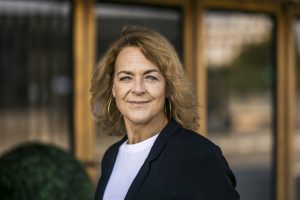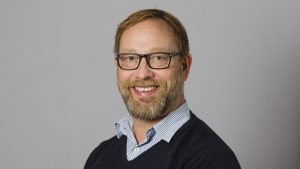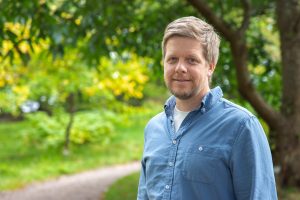
The students are paying close attention to the presentation listing the advantages of working in Denmark, given by information officers Karin Edstedt and Frida Theander at Furuboda Folk High School in Malmö.
“I met Karin and Frida during an information meeting at the Swedish Public Employment Service and asked them to visit us. It was a very good visit which provided hope and knowledge about what can be found on the other side of the sound,” Karin Berg, the school’s labour market coordinator, tells the Nordic Labour Journal.
Read this article in Swedish on Arbeidsliv i Norden
The two information officers are employed by the Skåne County Administrative Board as part of the three-year Interreg project “Border commuting across the Öresund with a focus on young people”.
Their role is to inspire young people and raise awareness about the opportunities in this, the southernmost of the Nordic border regions.
The Interreg project is a collaboration between Öresunddirekt/the Skåne County Administrative Board, Øresunddirekt/Greater Copenhagen, the Øresund Institute, Roskilde University, Lund University and Region Skåne.
Last spring, the two information officers met around three thousand people, mostly those who are part of the target group – young adults between 18 and 29 – to provide them with just that; hope and knowledge.
“We talk about how Denmark has higher wages than Sweden and a shorter working week. That they can gain international work experience without moving abroad and that speculative job applications are generally more welcomed by Danish employers than Swedish ones,” says Karin Edstedt.
During the presentations, they also make sure to demonstrate how job advertisements on Danish job-search sites work, and to provide information about Nordjobb, which helps young people find seasonal work.
They meet their target group in classrooms, like the one at Furuboda Folk High School, at komvux (municipal adult education), in year three in upper secondary schools, at various career and job fairs and also at information desks in school canteens.
“Both teachers and pupils have approached us and sat down for a chat after lunch and have shown genuine interest. At the most, we’ve been speaking with 140 people during the two hours we’ve spent at a table,” says Frida Theander.
Better use of the region’s workforce
The information officers say they feel that their mission to raise awareness and provide information about the opportunities available in the Öresund region is both important and meaningful. They have backing from the highest levels.

When the Öresund Bridge turned 25 last year, the prime ministers of Denmark and Sweden signed a declaration for both countries where they underlined the need to “better use the region’s workforce”.
But Skåne still has many jobseekers while East Denmark has a large number of vacancies. The report “Labour across the Öresund – the matching potential in Greater Copenhagen 2026” lists the eight relevant sectors: construction, sales, hospitality, electronics, IT, education, administration, health and social care.
“Yes, the project is really topical. Several of these jobs also do not require a high level of education,” says Frida Theander.
During the brief time she was unemployed herself, she wished that someone had opened the kind of doors that the Interreg project now does.
Knowledge and mental barriers
When the information officers meet their target groups, they try to reduce the knowledge gap and break down the mental barriers they encounter.
“For some young people, commuting across Öresund seems more alien than moving to Stockholm,” says Frida Theander.
They also see upper secondary school leavers who are worried and would rather start working than carrying on studying.
“They wonder what to do when school is over, so it’s not difficult to reach them with our message,” says Karin Edstedt.
There are two additional factors that add to the uncertainty about applying for jobs or education in Denmark.
One is the Danish language.
“I couldn’t speak Danish myself when I was working in Copenhagen, but I gradually learnt it because I was surrounded by the language.
“Not all jobs in Denmark require you to speak Danish either. If you want to learn it, it’s smart to watch Danish films and TV-series, and there are plenty of them,” says Karin Edstedt.
Another factor is the price of train tickets to Denmark.
A 30-day ticket with Skånetrafiken from Malmö to Copenhagen costs 2,780 Swedish kronor (€250), while a similar ticket with Stockholm Public Transport costs 1,030 Swedish kronor (€93).
None of these prices include the temporary subsidy that the Swedish government introduced for these kinds of public transport tickets, which runs out at the end of the year.
It is also a fact that wage levels in Copenhagen, the capital city, are higher than in Skåne and that the exchange rate means Danish wages are worth more when turned into Swedish kronor.
Education opportunities on the other side
The two information officers also meet Danish vocational education providers, such as the Hotel and Restaurant School in Copenhagen, SOSU H, a state institution in Copenhagen offering training in healthcare, care and education, as well as providers of apprenticeship programmes, where part of the training is paid.
“Alongside our information job, we also try to build up a knowledge base to map Danish educational opportunities that are available to Swedes,” says Karin Edstedt.
Øresunddirekt’s various contact points
Frida Theander and Karin Edstedt have their offices at Øresunddirekt Malmö. This is an information centre which is open every weekday for people who have questions about working, studying or moving to Denmark or Sweden, as well as for all interested border commuters – regardless of which way they are travelling.
Staff from the Swedish Public Employment Service, the Swedish Social Insurance Agency, the County Administrative Board of Skåne and the Swedish Tax Agency are based here.

The Øresunddirekt web editorial team, however, is based in Copenhagen. There, the Nordic Labour Journal meets communications officer Åsa Setterquist, who works with social media for the Interreg project.
She is one of the growing number of people who commute from their home in Sweden to work in Denmark.
Åsa asks questions.
“How can we help young adults discover what is available to them on the other side of the bridge? And how can we reach all those who don’t know that they can visit Øresunddirekt in Malmö?”
And she provides the answers.
“I post on TikTok and Instagram. Posts that showcase people who’ve already taken the step and can function as role models who can talk about what it’s like to commute across Öresund.
Increase in the number of young commuters across Øresund
“The digital initiative has been a great success, with a significant increase both in the reach of our posts and in the engagement they generate,” says the communications officer, who was hired when the Interreg project provided funding to strategically develop the organisation’s presence on social media.
“We reach more young people than before, and we also see that many interact with the content. They post comments. They save. They share. All this is great proof that our posts are relevant to the target group.
Åsa Setterquist uses various strategic formats like inspiration and humour to create interest in the opportunities that exist across the sound. Alway with the same purpose:
“If someone sees the post and think they too can apply for a job in Denmark, well, then we have succeeded,” says Åsa Setterquist.
Statistic drew reactions
Numbers can create confusion. Even when they are negative.
Malin Dahl is head of Øresunddirekt in Malmö and was among those who reacted when an analysis from the Danish-Swedish knowledge centre Øresundsinstituttet showed that the number of young commuters fell sharply between 2007 and 2022.
“Even before the pandemic, I was thinking that we weren’t reaching young adults with our information and that we should do something about it. But our limited resources would not allow us to do anything major,” she tells the Nordic Labour Journal.

The Danish Chamber of Commerce had noticed the analysis and asked Øresundsinstituttet’s CEO Johan Wessman to launch an Interreg project to gain a better understanding about developments in the cross-border labour market.
There was also considerable interest in young cross-border commuters from the Capital Region of Denmark. Employment has continued to rise in Denmark, which has put greater focus on the possibility of recruiting workers from Sweden.
When Malin Dahl and Johan Wessman were preparing a joint border obstacle conference in the spring of 2024, they realised it would be wise to cooperate on a common project rather than doing things separately.
The idea was simple.
Øresunddirekt would step up their efforts to inform pupils and also reach young adults through digital information. Øresundsinstituttet would apply research and analysis to create new and more comprehensive knowledge around young people’s cross-border commuting for the benefit of both Øresunddirekt and employers.
The cooperation led to a pilot project that was approved by Interreg Öresund – Kattegatt – Skagerrak and laid the foundation for an application for a three-year project, which was approved and got underway in the autumn of 2025.
The project also involves researchers from Roskilde University and Lund University as well as analysts from Region Skåne.
The project is led by the County Administrative Board of Skåne, and the target groups for its information activities also include the Swedish Public Employment Service and municipal employment services.
The aim of the project is to use new knowledge and improved access to information to encourage more young people to take advantage of opportunities for work and education on both sides of the Øresund.
A broad front
The communication work using both physical and digital channels makes up one of the project’s three parts. The two others are New knowledge and New networks.
“At Øresundsinstituttet, we are good at analysis and at bringing Danes and Swedes together.
“We also have an extensive network of contacts throughout the Øresund region, but we need to learn from others about how best to engage with young people,” says Johan Wessman.
Øresundsinstituttet and its partners create new knowledge and networks
The universities
Media researchers Jesper Falkheimer from Lund University and Mads Kæmsgaard Eberholst and Mark Ørsten, both from Roskilde University, will examine young people’s attitude to the Öresund region and commuting, plus look at their media habits. The researchers have sent out surveys to 2,000 young people in Eastern Denmark and Skåne to map their attitudes to cross-border commuting.
The businesses
The aim is to expand the network of employers with employees who commute across Öresund from the current 33 members to 50 businesses by the end of the three-years long Interreg project. The companies should share their knowledge and skills development, and will at the same time benefit from the project’s research findings.
The Öresund database
Region Skåne is developing the Öresund data base which contains statistics in table form on cross-border commuting in the Öresund region, combining data on industry, age group and citizenship among Öresund commuters.
Youth databases
Øresunddirekt Danmark has a network for young people that is managed through a database developed by Øresundsinstituttet. The Database is also used to distribute surveys and to manage Øresundsinstituttet’s network of businesses and civil society organisations across the Öresund.
Civil society
There has been a growing realisation at Øresundsinstituttet that all parts of society need to be involved and that cross-border contacts should be established from an early age. The institute is therefore building a Danish-Swedish civil society network that already includes organisations such as the Skåne Football Association, FC Rosengård, the Danish Football Association, Fryshuset, Kulturværftet in Helsingør and The Tivoli in Helsingborg.
As a non-profit organisation working to generate new knowledge and build new networks, Øresundsinstituttet receives additional project funding from:
Four municipalities: Malmö, Copenhagen, Helsingborg and Helsingør.
Two regions: the Capital Region of Denmark and Skåne.
Four companies: SAS, Ingka Group (IKEA Retail), Boozt Fashion and the Øresund Bridge Consortium.
Coordination and renewal are necessary
There are more initiatives in the pipeline. In September, Øresundsinstituttet will launch Make your voice heard as a commuter where all age groups are encouraged to register basic information like how long they have been commuting for, where they live and what sector they work in.
“What are the five greatest obstacles to commuting across the Öresund? That is what we want answers too. So the networks in the Öresund region are multiplying and different segments are being linked,” says Wessman.
“For us, this is more than a project. It’s also an opportunity to renew the way the institute works in the longer term.
“At the meetings I attend that concern the region, I am one of a group of middle-aged people in decision-making positions talking about young people who aren’t there.”

The new approach also includes a new communications strategy, in which different aspects of the Interreg project’s findings will be presented in engaging videos on YouTube, as well as shorter clips on other social media platforms.”
“That’s why it is important that we have the media researchers onboard,” he says.
Last, but not least, Johan Wessman wants to highlight the importance of the physical meetings that are taking place across the different networks, like at Øresunddirekt in Malmö.
“The staff there have their feelers out and gather a lot of valuable knowledge.”
Øresundsinstituttet will shortly publish a six-month report covering spring 2026, detailing the new knowledge generated by the Interreg project.
More good results
As Karin Edstedt’s and Frida Theander’s manager, Malin Dahl is happy that the first year of the project has gone so well.
“We are happy that Karin and Frida have been so warmly received as they spread the word about the opportunities on the other side of the sound.
“Some of the schoolteachers have already asked them back to meet next year’s third-year cohort, and that is a great endorsement,” she says. She is also looking forward to welcoming many more young visitors to the information centre in Malmö.
Comparability of youth unemployment in the Öresund region
Unemployment is more difficult to compare across national borders than employment. While employment has a clear international definition, unemployment is more strongly influenced by how different countries’ labour markets, education systems and social security systems operate.
In the Öresund region, young people aged 16–24 have a significantly higher unemployment rate in Skåne than in Eastern Denmark (the Zealand and Capital regions).
In Skåne – as in Sweden as a whole – however, they also have a significantly lower rate of labour market participation. This is because a large proportion of this age group are students. Student working alongside their studies, often in cooperation with relevant employers, is more common in Denmark, which also has a more developed apprenticeship system. This means that more young Danes are active in the labour market, even though many are also studying at the same time.
Labour market participation is more similar among those aged 25–29, at 79 per cent in Skåne and 81 per cent in Eastern Denmark. In this age group, 8 per cent are unemployed in Sweden compared with 4 per cent in Denmark, which may partly reflect the fact that Danish young people are more likely to have previously been active in the labour market. For the reasons outlined above, however, comparisons should be made with some caution.
Sources for the figures: Statistics Sweden (BAS), Statistics Denmark (RAS), Region Skåne calculations.
Text: Öresund Statistics