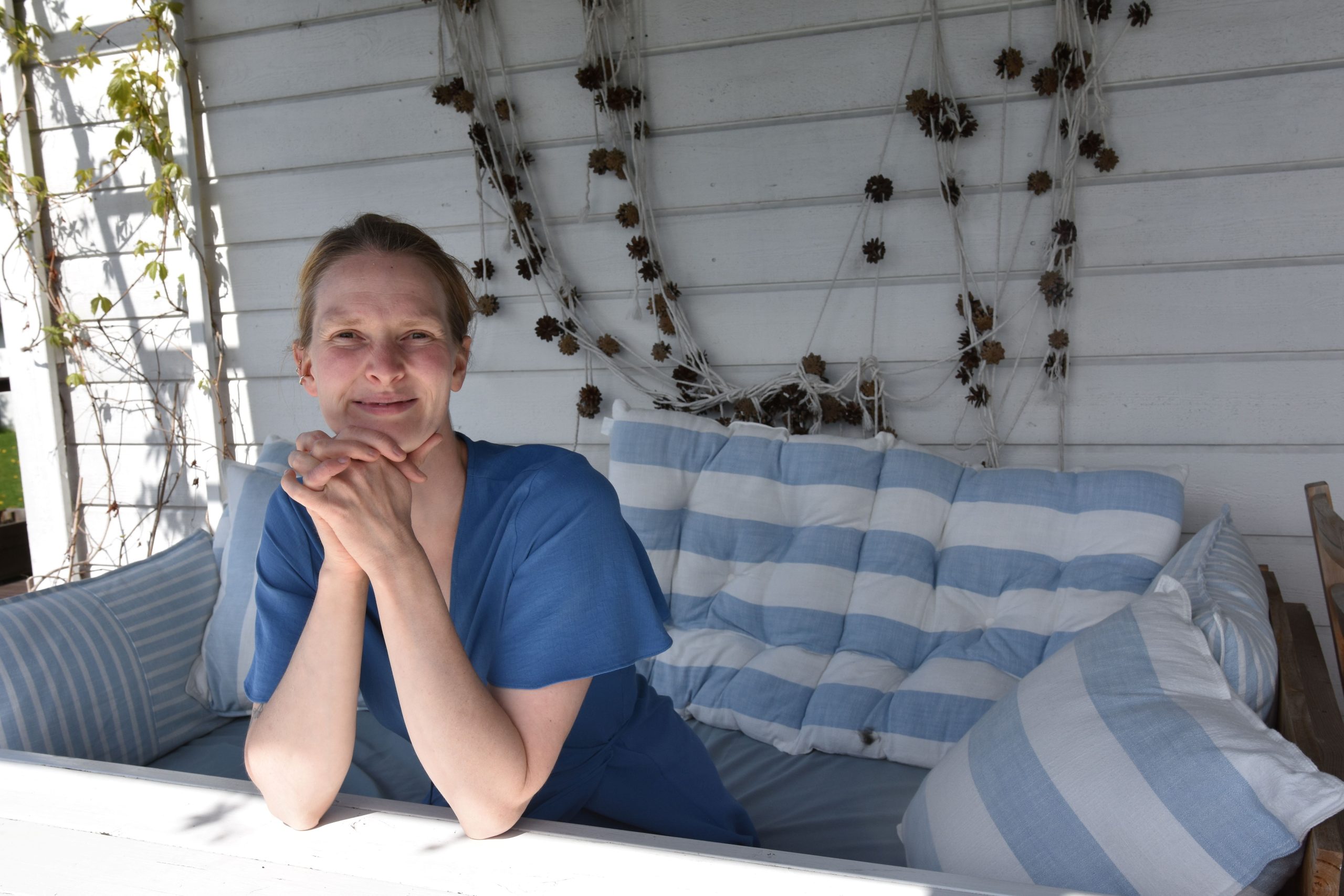
The spring sun is out, and a little boy aged eight months is crawling around on the veranda floor, exploring his surroundings.
But he is not alone. Mummy is watching.
Read this article in Norwegian on Arbeidsliv i Norden
Sunniva Johanna Troll Imhof is at home on parental leave. She knows very well the difference between being self-employed and a permanent employee.
“My husband has a permanent position, and I know many mothers who are also employed. So I know which rights and security they enjoy which I don’t have.”
She has been lucky. Two healthy pregnancies with no complications.
“I have been healthy and full of energy. Yet you also feel that there really is no room for illness when you run your own business. Sometimes it might feel tempting to take a little break, but that’s not easy when your income immediately stops.”
As a self-employed worker, she has to wait 16 days before receiving sickness benefit.
“Of course you think about it. If you are ill, you lose your income. Reduced working capacity equals reduced wages. So simple – and so difficult.”
The couple have had two children in rapid succession. This has also made parental leave an economically challenging period.
This time, she is taking some unpaid leave. It gives the family the opportunity to spend some time together.
“I’m enjoying it, being able to be together all four of us. Life is a gift. But it’s not ideal financially. It’s a bit sad that this is the way it is.”
From Norway to Germany to Norway again
The 33-year-old grew up in Lørenskog near Oslo with German parents. It was not difficult for her to choose to study physiotherapy in Germany.
In 2017, she got her bachelor’s degree from SRH University Heidelberg.
She also met her husband in Germany.
“I worked in clinics and rehabilitation centres as a permanent employee. That’s the norm in Germany. When I tell people there that I’m a self-employed physiotherapist in Norway, they think it sounds very fancy.”
Norway and the Nordics bottom in Europe
The Nordic countries have far fewer self-employed workers than the EU average. Norway is bottom of all the countries according to Eurostat.
At around 4 per cent, Norway has the lowest share of self-employed workers out of all the countries that are mapped by the European statistics agency.
Sweden and Denmark are at 6 and 7 per cent. Finland and Iceland are somewhat higher, but still below the EU average of 13 per cent.
There are more men than women among the self-employed in most European countries. This is also the case in the Nordics.
Please note that the figures vary somewhat depending on which statistics, reports and definitions have been used in relation to self-employed workers. This also means the figures are not necessarily fully comparable.
After a while, the couple moved to Norway and settled in Drammen. They now have two children together.
Around half are self-employed
In Norway, it is far more common for physiotherapists to be self-employed. Figures from various sources paint roughly this picture:
Around 30 to 35 per cent of practicing physiotherapists are self-employed without a municipal service agreement.
Around 20 per cent are contracted physiotherapists with a municipal agreement.
The remaining 45 to 50 per cent are permanently employed in the public sector.
A municipal service agreement allows physiotherapists to provide publicly funded services.
Six months with no pay
Before she could start working as a physiotherapist in Norway, Sunniva had to have her German qualifications approved.
That meant working in the municipal health service with no pay.
In principle, such placement periods are not unpaid. But municipalities can choose whether or not to pay people in placements. In practice, this means that other financial priorities take precedence, and placements remain unpaid.
“That was incredibly hard financially. I have never been as broke as I was then. You get used to having little money when you’re a student, but this was something entirely different.”
She is glad that her husband had a job.
“When I was approved, it almost felt like I started anew.”
She could have chosen a municipal job or to work in the health service. But her experiences from her practical training period made her uncertain if that was the right way to go.
Made a choice
“When I worked in municipal healthcare, I realised that the municipality and I disagree over certain aspects of treatment. Both can be good, but I wanted to work in my own way.”
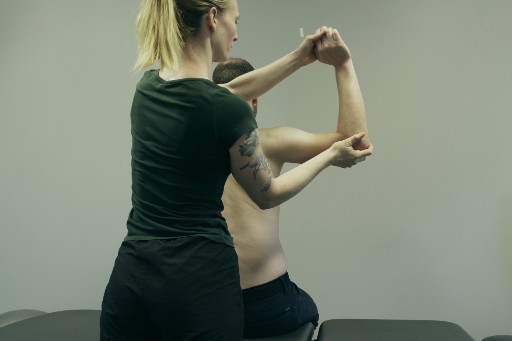
She describes herself as a “hands-on physiotherapist”.
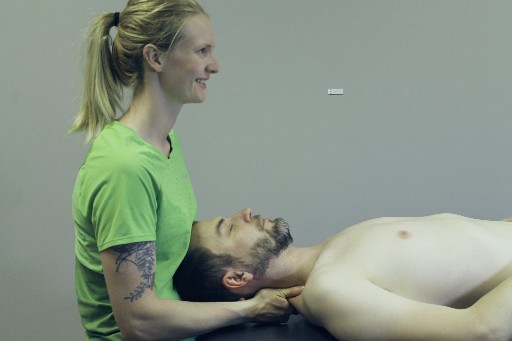
“I use a lot of manual techniques. My hands are my most important tools. I also use methods like dry needling, cupping, floss band therapy and exercises.”
Her freedom means a lot.
“I don’t think I would have been happy as a municipal employee. Being self-employed allows me to work in the way I want and to stand by my values.”
She calls going self-employed a “semi-conscious choice”.
“I like the freedom. When you work in a clinic you also have a lot of freedom in the treatment room.”
Several income streams
She set up as a sole trader, as many physiotherapists do. Since then, she has worked in private clinics, at rehabilitation centres and doing home visits in the Drammen area.
She now offers services like home treatment, occupational physiotherapy, massage and group training.
“I also work on my visibility. There is a need out there, but people have to know that I exist.”
Life at the clinic
Many physiotherapists start their working lives in a clinic, where you have to rent a space as a self-employed worker.
“It can be a slow start. You have to create your own patient base, which takes time.”
Much of the income, anything from 40 to 50 per cent, often goes to the clinic.
“I worked days at the clinic and took evening shifts in a nursing home. Luckily, we didn’t have any children back then.”
More self-employed workers on lower pay
A 2025 report from Statistics Norway shows that self-employed workers face larger income inequality than regular salaried employees.
12.4 per cent of people whose main income is from self-employment are on a low income. When both income and wealth are included, 5.9 per cent are classified as “income and wealth-poor”.
The report also shows that certain sectors are particularly exposed. Courier services, cleaning, hairdressing, and arts and cultural professions have the highest shares of workers on low income.
The report was commissioned by the Norwegian Ministry of Labour and Social Inclusion.
She calls the first years very demanding financially.
“When you start working, you do expect to make money. I don’t think I have ever been that broke.”
Set up her own practice
She reached a turning point when someone asked her if she offered home visits, which she had not really started doing.
“Then I thought – why not?”
Now, home visits are an important part of her business.
“When I return from parental leave, I have enough patients to fill two days just doing home visits.”
She enjoys this way of working.
“You have to build good relationships over time. My original patient has been with me for four years now.”
Her financial situation is also better.
“I make much more from home visits than from working at a clinic. I don’t have to pay anyone apart from the tax authorities.”
She aims to fill her entire working week with home and workplace visits.
Picking up knowledge
Self-employed workers have to handle their everyday job themselves, but also accounting, tax and other administrative tasks.
“I learned a lot online, really. And from my mother, who is also a self-employed physiotherapist. And from self-employed colleagues at the clinic.”
She does the administrative work herself.
“I was incredibly stressed the first time I did my tax return. Had I set aside enough? Would I get a big tax bill? Fortunately, it went well.”
She has gained more control over the years.
“I now have a better overview of what I will be earning.”
When bills and taxes have been paid, she tries to save some money.
“I’ve started saving for my pension. I have to look after myself.”
She wants to be financially independent.
“My husband should not have to support me. I need to have pension savings of my own.”