

And let us right away address one of the questions many have asked: the one about Gen Z and working life. Is this generation as difficult as some seem to think?
We are talking about those born between 1995 and 2010. Gen Z have been given many generation labels, not all of them flattering.
Read this article in Norwegian on Arbeidsliv i Norden
They have been called a lazy, fragile and demanding generation, a bunch of people you would do better than to employ, and there have been several stories in the media that go something like this:
“Gen Z are harder to lead than other generations”.
So just how demanding are Gen Z, we asked Øystein Bonvik. After working on his book “Four generations at work”, he believes this cohort has been given an undeservedly bad reputation.
Yes, Gen Z is the coming generation of workers, but in Norway less than half of them have entered the labour market. They have also not had time to be shaped by working life, Bonvik reminds us.
More about Gen Z later.
Studying the interaction between generations
Øystein Bonvik is a communications advisor, lecturer and author of several books including “Tempt me not into leadership”.
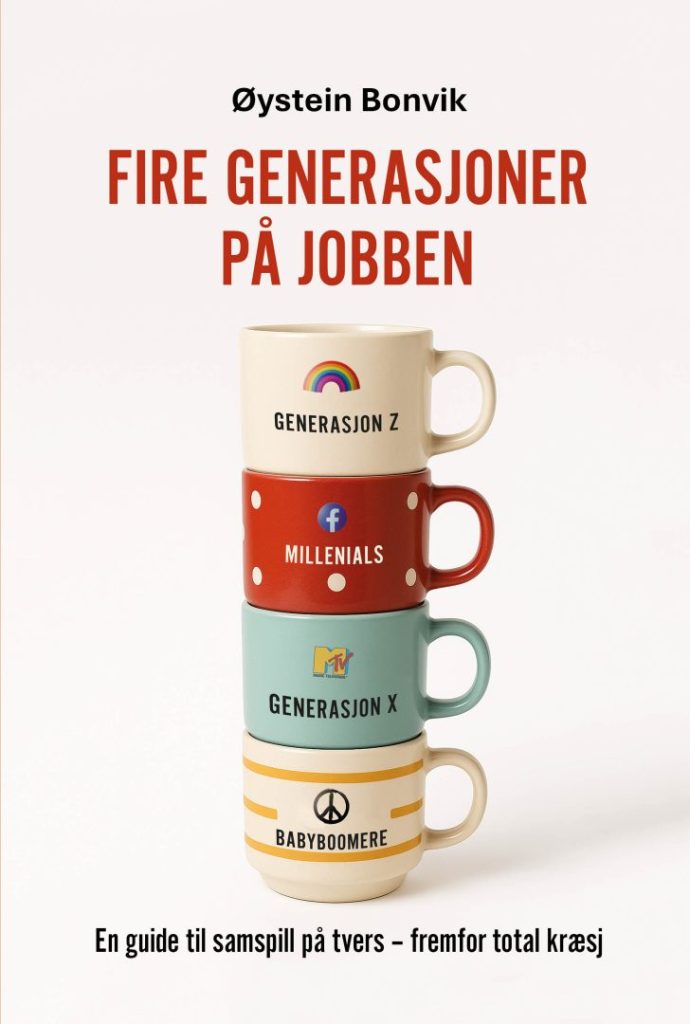
The book is a kind of guide to cross-generational interaction – rather than total conflict. Published by Bonnier Forlag.
His new book, “Four generations at work”, is based on research, other relevant literature, a survey carried out for this particular book and on Bonvik’s own experience from working with companies that find themselves in the middle of generational challenges.
He wanted to find out more, not only about Gen Z, but all the generations who are currently in the labour market, and study the interaction between them to perhaps find out what each generation should work on to make everyday working life run as smoothly as possible.
Since its publication in May, the book has enjoyed a lot of media attention in Norway. The article’s comment sections have also been busy.
The four generations
Øystein Bonvik was born in 1971, which makes him Generation X, and his first day at work was in 1995.
He says this was a time when you were still happy to have a job and even for the fact you were getting paid, albeit not very much.
“But that’s not necessarily the case for workers born after 1980. Their attitude is more along the lines of ‘the labour market should be happy I exist’”, says Bonvik.
We will return to the interesting divide between workers born before and after 1980. But first, we find out more what Bonvik’s book says about these four generations and what characterises them.
Baby Boomers (born 1946 – 1964)
You know you are a Baby Boomer at work when you:
- Write meeting notes in full sentences
- Get genuinely irritated when people turn up unprepared
- Want to solve things quickly
- Believe that responsibility is something you take, not something you get
Known for: Company loyalty, experience of long-term work, institutional understanding, consistency in delivery and the ability to remain in challenging situations over time.
Generation X (born 1965 – 1980)
You know you are Generation X at work when you:
- Understand Teams and miss the time before everyone could reach you all the time
- Are used to “just making it happen”
- Get stressed by inefficient processes but not by a fast pace. Appreciate clear expectations
- Is often left with the impression you are the glue holding the organisation together
- Known for: Independence, pragmatism, a sense of responsibility, the ability to balance demands and resources and having experience from workplace restructuring and change.
Millennials (born 1981 – 1996)
You know you are a Millennial when you:
- Balance ambitions, self-development and a sense of guilt roughly at the same time
- Love structure but get frustrated when the room for manoeuvre is smaller than the responsibility
- Want to perform while also having a life outside of work
- See working life as more of a marathon than a sprint
Known for: The ability to cooperate, focusing on development, willingness to learn, value- awareness and the ability to combine expertise, technology and relationships.
Generation Z (born 1997 – 2012)
You know you are Generation Z at work when you:
- Feel motivated but are also a bit uncertain about the rules of the game
- Want to do a good job but would like to know what is actually expected from you
- Is more sensitive to unclear norms than high demands
- Find it strange that so much is “implied” rather than explicitly stated
Known for: Being safe around technology, tempo, initiative, the ability to navigate in complex information environments.
First Norwegian survey
To avoid basing the book just on myths and anecdotes, and to gather more knowledge about generational differences in the workplace, Bonvik worked with Opinion, Norway’s largest market and public opinion research company.
They carried out what was Norway’s first major survey of how different generations view working life.
1000 Norwegian workers participated, evenly distributed across the four generations who meet in today’s labour market. The survey was conducted in October 2025.
Respondents were not directly asked about generational conflicts but were instead asked about situations in which such conflicts are often assumed to arise.
The starting point was concrete work situations which might lead to friction: collaboration, tempo, expectations, responsibility and the experience of being seen and taken seriously.
Younger workers are more often frustrated due to age differences
One of the survey’s main findings was that across the generations, 8 in 10 said cooperation in the workplace works well.
At the same time, the findings suggest that a certain amount of frustration and friction is rarely expressed openly.
Another interesting find: Around 3 in 10, regardless of age, feel more is expected from them at work than what has been formally agreed. In other words, work pressure does not appear to be a generational issue, but a workplace issue.
A need for a common language
So, most people do manage to make working life function across the generations. There are few, if any, signs of inter-generational conflicts and there is definitely no generation war.
But according to Bonvik, this does still not mean we can talk about a frictionless working life. He calls what happens in some workplaces “quiet friction”.
“It’s often the little things: questions that aren’t asked, disagreements that aren’t addressed, or expectations that are never resolved. Quiet friction impact cooperation without necessarily being vocalised.”
Bonvik writes:
“Most workplace misunderstandings do not happen because people wish each other ill, but because they expect different things – without saying them out loud.”
Bonvik argues it is important to be able to go from “quiet friction to a common language” in the workplace.
But it is not necessarily that simple. Bonvik believes it can be smart to start with yourself and ask the following questions:
- What do I actually expect in terms of response time – and have I made that clear to others?
- When do I myself feel expectations are unclear?
- Which words do we use and assume everybody understands them the same?
- When do differences become a problem and when are they just variety?
- What could have been said at an earlier stage?
- What do I need to know myself to be sure I’m heading in the right direction?
- What do you mean with “as soon as possible”?
What do you mean, “as soon as possible”?
Bonvik is particularly interested in the use of words and expressions, because he believes much of workplace friction occurs not because people disagree on what is important, but because they attach different meanings to the same words.
Younger workers: unreasonable when work demands more than what was agreed
One example he uses often is to ask people how they interpret the fact that a task should be done “as soon as possible”.
Bonvik himself interprets that as if the task has top priority. He puts everything else aside and performs the task immediately.
But he sees that younger generations interpret this more like the task should be done “once I’ve finished the other things on my list”.
“My point is not that one thing is correct and the other is wrong. But we are all responsible for the smooth running of the workplace, and that means interpreting words and expressions more or less in the same way.”
To continue that argument, Bonvik says it could be smart to learn how to understand the generational differences at work rather than being irritated by them.
“Let’s say you’re Gen Z and meet a leader like me, a Generation X. Knowing something about generations could tell you something about how I as a leader want things to be and what expectations I have of you.”
The youngest workers seek safety
The survey also shows that the oldest workers seek more meaning while the youngest seek safety. 78 per cent of the Baby Boomers say that meaningful work is among the most important factors for wellbeing.
Older people seek meaning, younger ones a good salary
The youngest, meanwhile, feel that they are not being taken seriously at work.
“Many think that meaning is mainly something that is valued among the youngest workers. The survey shows that this is something the oldest workers care about,” says Ola Gaute Aas Askheim, senior advisor at Opinion.
Askheim believes this finding challenges the idea that older workers are mainly looking for calm and safety.
Yet it is Gen Z who needs safety, explains Bonvik. They want a safe job and a well-paid job.
“Gen Z are not helpless. But they are scared of making mistakes. As I see it, this is the first generation not to use its mandate to say that they’re young and inexperienced and therefore might make mistakes.
“If you are a leader looking for someone who’s willing to bring fresh ideas and take some risk, I would recommend hiring a 45-year-old. But if you’re looking for a stable, loyal employee who would like to do everything by the book, hire a 25-year-old,” says Bonvik.
At a crossroads in 1980
It is also interesting that workers born before or after 1980 experience working life differently.
Baby Boomers and Generation X give pretty similar answers, while Millennials and Gen Z share many traits.
Baby Boomers and Generation X interpret loyalty as “loyalty to the company, they are not concerned with working alongside people at the same stage of life, and they value having meaningful work”.
Millennials and Gen Z, however, feel frustrated because of age differences and say good pay is important for their wellbeing.
Ola Gaute Aas Askheim at Opinion wonders if technology could be an important variable.
“Those born around 1980 and later will have spent their formative childhood and teenage years increasingly influenced by computer games and an ever-present internet.
“Another element that might throw light on these differences is how society during the 80s gradually shifted to accept conspicuous consumption to a much greater extent than during the first decades after the war,” says Ola Gaute Aas Askheim.
No recipe but some advice
Bonvik has no simple recipe for how workplaces can avoid the so-called quiet friction. He also underlines that we must accept that the differences do not disappear. The question is what we do about them.
In his book, he has some advice to the labour market:
- Talk about differences without resorting to caricature
- Make expectations explicit
- Mix experience and speed in a conscious way
- Recognise that motivation looks different to different people
- Avoid “one size fits all” leadership
- Build a culture of curiosity, not irritation
- Talk about it before it turns into a conflict
He also writes about four approaches commonly found among leaders who succeed in improving collaboration over time:
- Clarify expectations before they have to be interpreted
- Talk about how you work, not just about what you work on
- Put teams together with more than professional expertise in mind
- Adapt follow-up without making it unfair