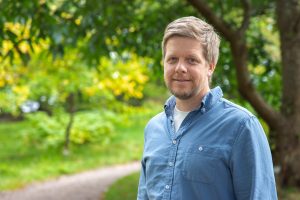
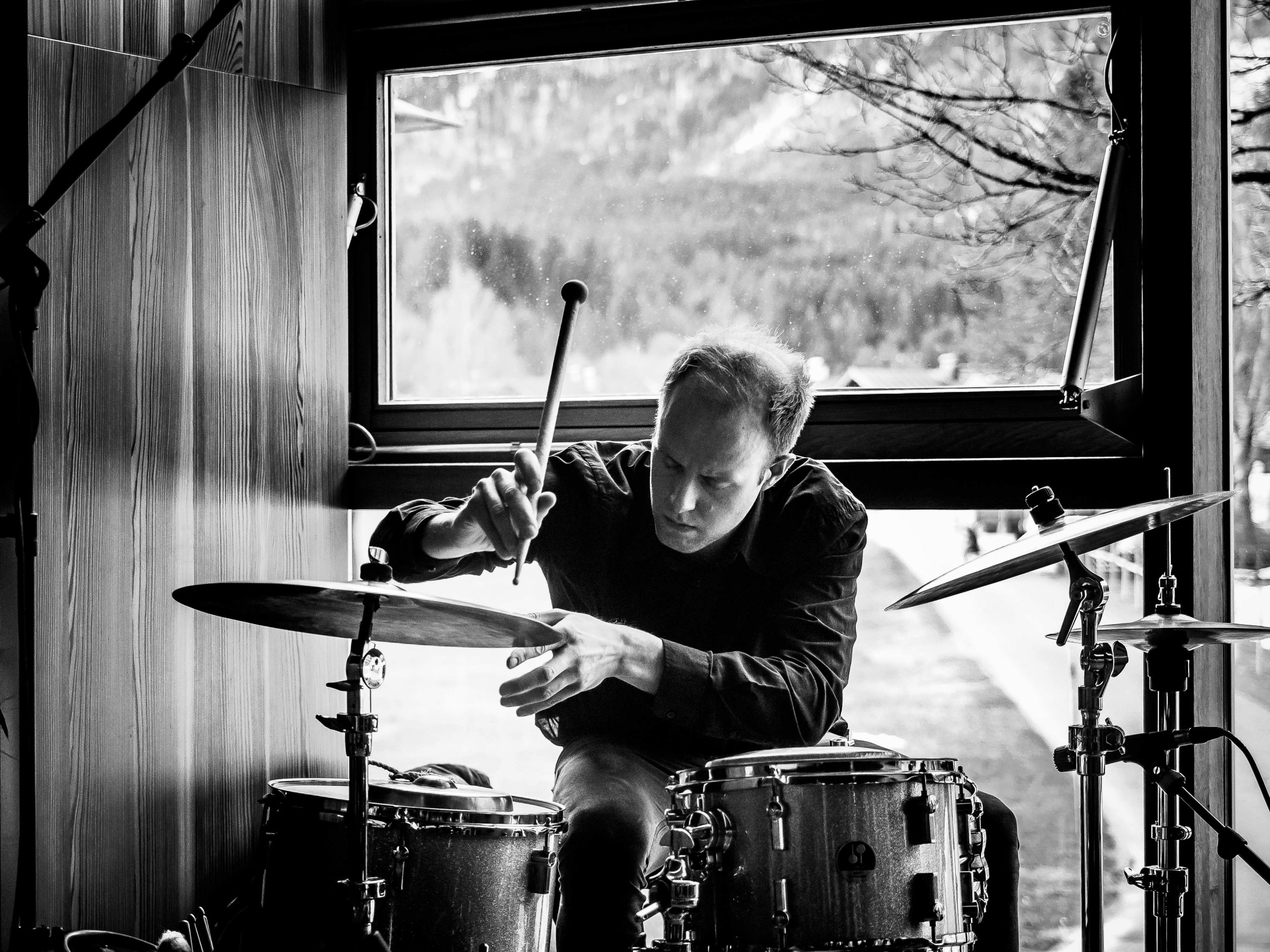
Jazz musician Tollef Østvang has never really been looking for a permanent job.
For him, being a musician is not first and foremost about security, but having artistic freedom.
Read this article in Norwegian on Arbeidsliv i Norden
“Being a jazz musician is not just a job for me, it’s more than that. I didn’t study music expecting to find a steady job when I had finished.”
The 41-year-old was born and grew up in Os in Østerdalen in south-eastern Norway.
He has now moved back there after spending many years in Trondheim. His address is Os, but his working life is still international and built around his life as an independent musician.
He regularly tours nationally and internationally and has contributed to a range of albums.
Having several strings to his bow
We talk on the telephone one afternoon. He has just returned home after spending the day working at the municipal culture school.
Østvang only started working at the school in his little municipality this year. He works part-time at 27 per cent, which translates to around one working day a week.
“There are several reasons why I took this job. It is nice to be able to give something back to the local community, while I also get a regular, stable income.
“The culture school headmaster appreciates having professional musicians on the staff. The position is flexible. In principle, I work one day a week, but if I for instance go on tour, they work around that and I can make up the working days later,” says Østvang.
In Norway it is common to combine music and arts education with pedagogy. That combination allows people to teach at institutions like culture schools, folk high schools and universities.
“I studied pedagogy between my bachelor’s and master’s degrees. Everyone in my class did. I don’t regret it. Teaching is rewarding.”
Prioritising artistic freedom
Østvang studied at the jazz programme at the department of music at the Norwegian University of Science and Technology NTNU in Trondheim, Conservatoire National Supérior de Musique et Danse in Paris and Coservatorium van Amsterdam.
He was based in Trondheim for several years before moving home to Os a few years ago. As a student he had already understood that his future would probably be as a self-employed freelancer.
Norway and the Nordics bottom in Europe
The Nordic countries have far fewer self-employed workers than the EU average. Norway is bottom of all the countries according to Eurostat.
At around 4 per cent, Norway has the lowest share of self-employed workers out of all the countries that are mapped by the European statistics agency.
Sweden and Denmark are at 6 and 7 per cent. Finland and Iceland are somewhat higher, but still below the EU average of 13 per cent.
There are more men than women among the self-employed in most European countries. This is also the case in the Nordics.
Please note that the figures vary somewhat depending on which statistics, reports and definitions have been used in relation to self-employed workers. This also means the figures are not necessarily fully comparable.
Østvang describes himself as a musician who is mainly driven by his own artistic projects.
“I guess I am the kind of musician who has strong artistic convictions and focuses on what I am passionate about. I don’t like creating music on other people’s terms.
“Some musicians enjoy contributing to many different projects. I am more focused on developing my own projects and my own expressions.
“When we were students, we soon realised that there will not permanent positions waiting for us when we graduate. Some genres, like classical music, offer some jobs but not enough.
“That’s why Norwegian artists and musicians, regardless of genre, look abroad at some stage or other.
“There are many positive aspects to the international part of my job. But one of the reasons we go abroad is that we don’t have enough arenas in which to perform our art in Norway. This shows that we have some challenges here.”
The Nordic Labour Journal speaks with Østvang just a few months after the jazz musician returned from a tour of Japan. He also works a lot in the USA.
But he has also been an active driving force in the music scenes in Trondheim, Os and Røros.
“You can’t sit on your ass. You have to make things happen. I think I have always liked that.
“You must have a passion for your own career and create arenas for yourself and for others. When we go on tour, it is natural to invite musicians back to Norway. This cultural exchange is important both for us musicians and for the audience.”
Dependent on grants
Most artists and musicians in Norway depend on subsidies and grant schemes.
“It’s fascinating and also sad that even those who make commercial music need grants to survive. That’s not a healthy sign for Norway’s cultural sector,” says Østvang.
He says competition for the available funding has increased since he graduated.
“This could be because there are more musicians and more arenas now, but the available grants have not grown.
“In Norway, compared to many other countries, more professional musicians do nothing but play.
“There are many internationally influential musicians who, alongside their music careers, have worked as electricians, taken shifts in healthcare or worked in record stores. This happens more often in other countries than in Norway.”
Second-tier social security rights
He worked in the care sector when he lived in Trondheim. He had his last nightshifts right before the 2020 COVID-19 pandemic.
The pandemic is a story in itself. But we can briefly mention that Østvang is happy he had quite a lot to do at that time, even though he too went through a few meagre years.
“It slowed down my career to an extent, but it created other opportunities too.”
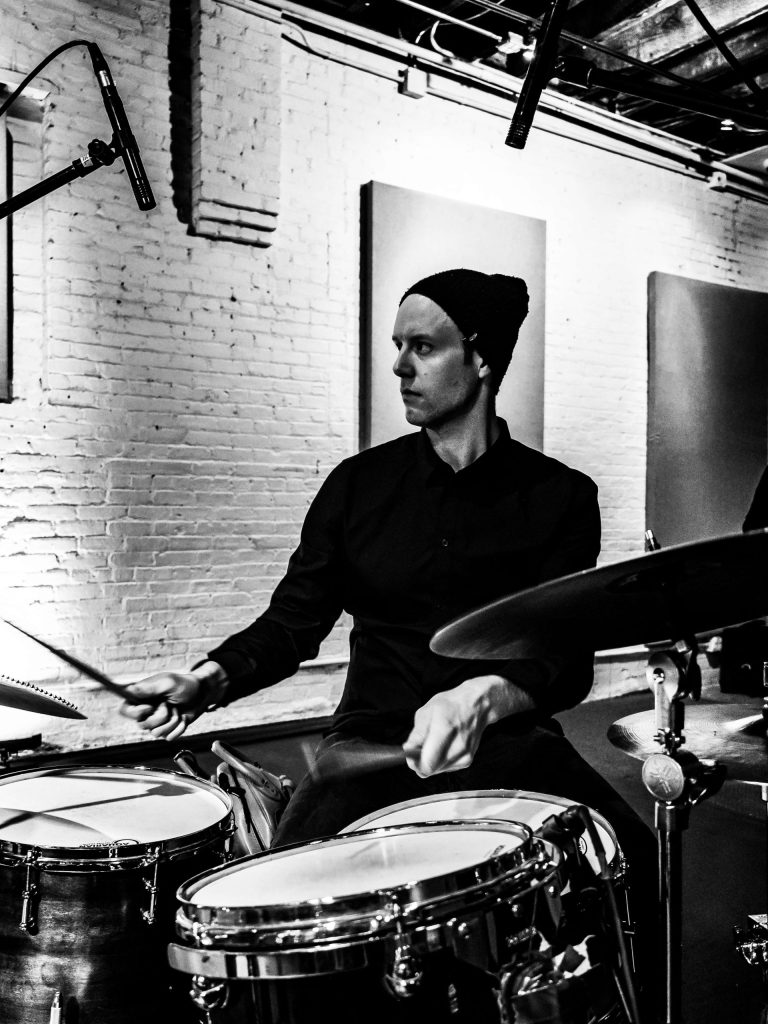
Østvang is a member of Creo, a trade union for art and culture workers under the Norwegian Confederation of Trade Unions, LO. He holds leadership positions at a regional level alongside other roles within the organisation.
He believes Creo did a good job during the pandemic securing help for artists and musicians through some difficult years.
Creo has worked hard to get wage and working conditions for freelancers and self-employed artists onto LO’s agenda.
The union was also a driving force behind the 2022 Fafo report “Welfare schemes for self-employed workers. Challenges and adaptations”.
The report shows that self-employed workers often have far weaker support than employees, especially when it comes to sick pay, unemployment benefits and pensions.
Some of the central findings were:
- They have a less favourable sickness benefit scheme. They receive sickness benefits from day 16 of illness, not from day one as employees do. They then receive 80 per cent of sickness benefits, not 100 per cent as salaried employees receive.
- They are not entitled to unemployment benefits.
- They do not have an occupational pension scheme, which employees receive through their employer.
Improved rights urgently needed
In Østvang’s experience, some of the people he has met in LO need some “adult education”. They need to understand more about what being self-employed entails.
For Østvang, the criticism of the schemes is not about a desire for permanent employment. On the contrary, he values the freedom that comes with being a self-employed artist. The problem, he argues, is that the systems are not adapted to them.
“Many of the people I meet through LO believe I’m self-employed because I have failed to find a job.
“But this is not about me not securing a job. It’s about me wanting to be independent and artistically autonomous. I want to be my own employer because I believe that is best for my art.”
The most urgent issue is to improve the social security rights for self-employed workers, believes Østvang.
“We have to take this seriously and create a framework to give self-employed workers the equivalent conditions that permanent employees enjoy when off sick or going on parental leave. And we need a collective pension savings scheme.
“I have not started saving for a pension. I haven’t had the economic room to do it. But that’s the next thing on my list.”
He does not think there is one correct answer to how to solve the challenges facing self-employed musicians. A range of measures are needed.
“You don’t need to do much to make it better than it is now. We should be allowed to expect the same framework as permanent employees enjoy in a decent labour market in Norway.”
There is little doubt, however, about what he himself wants to see happen.
“I don’t want to give up the freedom being my own boss gives me. I have to be able to define my own job. I believe this is a prerequisite for creating good music and art.”
Working to improve conditions
LO Selvstendig (LO Self-employed) was established in the autumn of 2018. It is aimed at freelancers, entrepreneurs and various types of self-employed workers.
LO Selvstendig is not a separate trade union but operates across all of the organisation’s affiliated unions. At present, LO does not have an overall figure for how many of its members are self-employed.
Potential members are offered improved membership terms, for example legal assistance and insurance schemes.
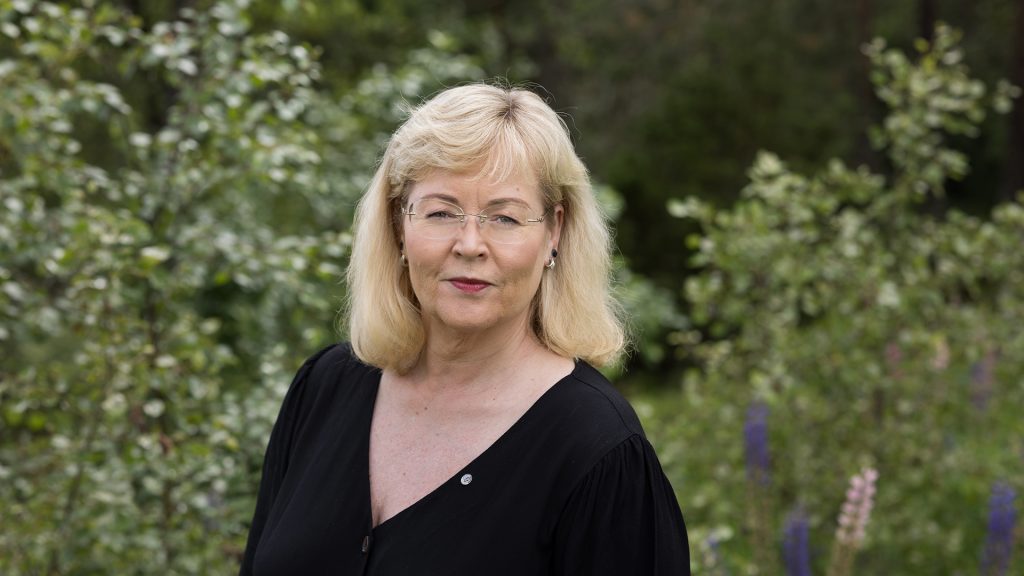
LO secretary Trude Tinnlund believes it is important to secure better social rights around pensions, sick pay and parental leave for self-employed people.
“The room for manoeuvre is different for self-employed workers because collective agreements and negotiations cannot be used in the same way.
“Right now, the most important work is therefore political advocacy to secure better schemes and to contribute to good information and guidance – both through the trade unions and towards NAV (The Norwegian Labour and Welfare Administration),” says Tinnlund.
Limited political will
The Fafo report “Welfare schemes for self-employed workers – challenges and adaptations” highlighted two areas as particularly problematic: income security during long-term illness and pensions.
“These are still the main challenges. So far, we have not found a good solution, and there is limited political will to address the pension issue.
“For LO, this is not only about the individual, but a structural problem: Large groups risk a facing a long working life without adequate income protection in case of illness and without a pension to live on,” the LO secretary says.
According to the Fafo report, solving self-employed workers’ and freelancers’ lack of proper income protection is best done through mandatory schemes, like some Nordic countries have adopted.
“We know from experience that voluntary schemes do not work well. One of the things LO has proposed as a possible path forward is a turnover-based contribution system, but we need more knowledge and must avoid solutions that create new loopholes,” Tinnlund says.