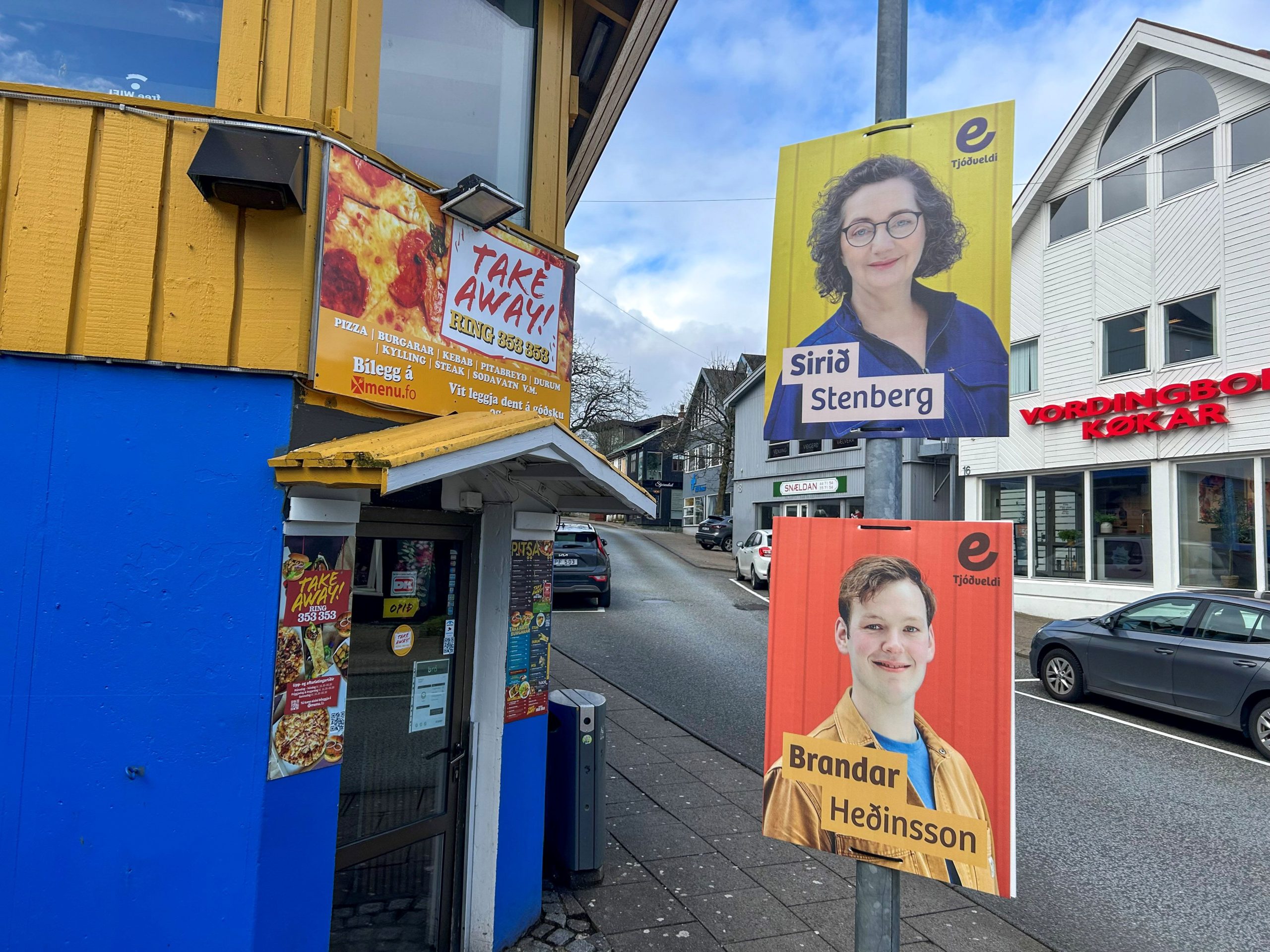
The law on free abortion up to week 12 was passed by the Faroese parliament in December 2025. But the law will not come into effect until July this year. With the parliamentary elections, several conservative forces now see an opportunity to roll back the much discussed legislation.
Results from the Faroese parliamentary elections 26 March 2026
Sjálvstýrið: 1 seat (3.6 per cent)
Fólkaflokkurin: 9 seats (26.7 per cent)
Sambandsflokkurin: 7 seats (21.5 per cent)
Javnaðarflokkurin: 6 seats (18.9 per cent)
Tjóðveldi: 6 seats (17.4 per cent)
Framsókn: 2 seats (6.6 per cent)
Miðflokkurin: 2 seats (5.3 per cent)
All polls point to a shift in the composition of the parliament.
Read this article in Danish on Arbeidsliv i Norden
The two left-leaning parties, Javnaðarflokkurin (the Social Democratic Party) and Tjóðveldi (the Republican Party), who have ruled in coalition with the liberal Framsókn party, are expected to suffer significant losses.
The two centre-right parties, Fólkaflokkurin (the People’s Party) and Sambandsflokkurin (the Union Party), have been in position together with the Christian-conservative Miðflokkurin (the Centre Party) for the past nearly four years.
Abortion trumps independence and gender equality
“These are parliamentary elections. But it is also a referendum on whether to roll back free abortion.”
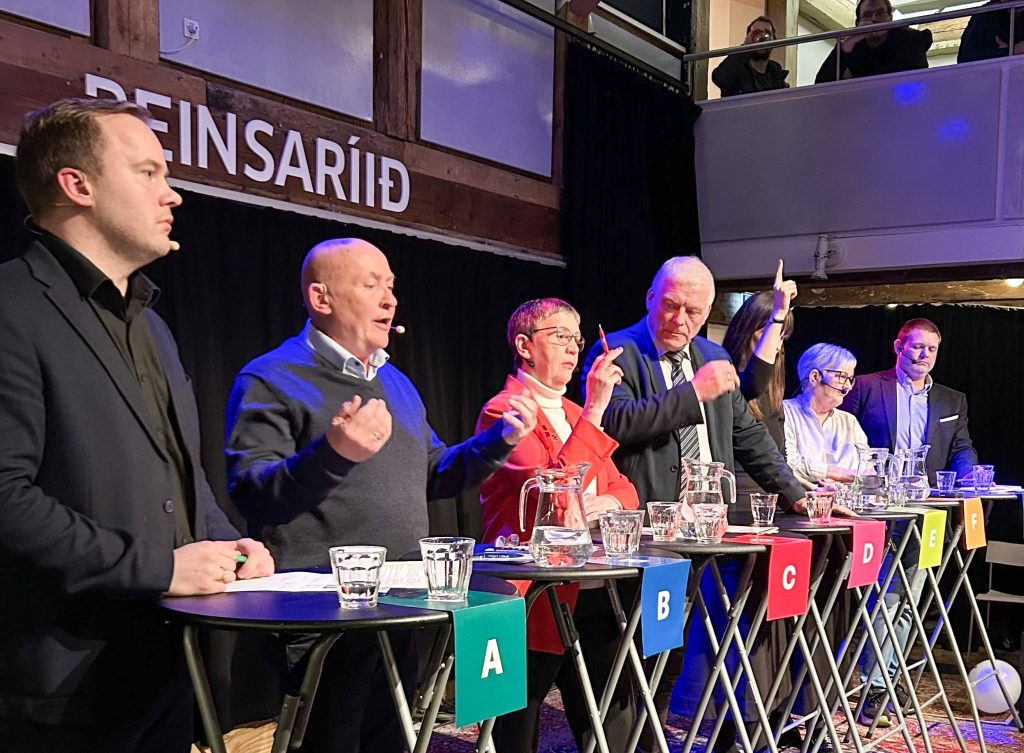
That was the blunt message from Karlot Hergeirsson from Framsókn during a debate hosted by the media outlet Fridhedsbrevet at Reinsaríið culture house in Thorshavn on Saturday evening.
Hergeirsson voted for free abortion in December 2025.
With that message, he points out that if polls are correct, there could soon be a parliamentary majority against free abortion.
One of those votes could come from the Miðflokkurin leader, Jenis av Rana, who has said his party’s most important pledge is to withdraw the law on free abortion.
Jenis av Rana’s party only has two out of 33 MPs, but much points to them being joined by more anti-abortion powers than the 16 from the party who voted against the law on 4 December last year, when 17 voted for.
The pro-live organisation Føroya Pro Vita has asked all candidates whether they are against free abortion. In the Fólkaflokkurin party, that looks set to be the big election winner, 23 out of 34 candidates are against abortion.
The latest polls show the party gaining at least three seats, up to nine from the current six. Slightly older polls give them even more.
That means there is a big chance that more will vote now in the next parliament, and that this could, as Hergeirsson put it, become a referendum on abortion.
So, abortion has once again become a central topic in the Faroes, despite the fact that it is a relatively small party which has made it its core subject.
It has been able to do this, because the topic is important to the Faroese. According to a survey for the national public broadcaster Kringvarp Føroya, abortion ranks higher for voters than both independence and gender equality.
Two elections in three days
Although some try to turn the parliamentary elections into a vote for or against free abortion, the Faroese will still be casting their ballots on 26 March. Just two days earlier, on 24 March, the Faroese were in the voting booths to cast a different vote.
Denmark’s parliamentary elections were held on Tuesday, and the Faroe Islands and Greenland have two MPs each there.
The Danish parliamentary elections have nothing to do with the Faroese parliamentary elections. As a result, the dominating issues are different. Abortion was not a theme in the Faroe Islands during the Danish election campaign, for instance.
People also vote differently in the two elections. In the 2019 Danish election, Sjúrður Skaale received 3,337 votes, but he got only 136 in the Faroese parliamentary election the same year.
In Tuesday’s election, Javnaðarflokkurin won 44.9 per cent, while it is projected to receive just 17.4 per cent in the Faroese parliamentary elections, according to a poll published by the media outlets Portal.fo and FM1 on Sunday.
Turnout also differs – around 90 per cent in Faroese parliamentary elections compared to roughly 70 per cent in Danish elections. However, turnout reached 75.5 per cent on 24 March.
Some had feared that holding the elections so close together would reduce turnout.
Election commentator Jóannes Hansen, mentioned in the media outlet Aldan, pointed out that in 1966 there were three elections within a single month: first a parliamentary election, then a municipal election and finally a Danish general election, where turnout was 48 per cent.
But participation was historically high in Tuesday’s Danish elections, and two records were set.
The record for the highest number of personal votes was previously held by Finnbogi Ísakson of Tjóðveldi, who received 4,490 votes in 1988.
On 24 March, Sjúrður Skaale received 10,823 personal votes, while Anna Falkenberg, who received the second-highest number of personal votes and became the second Faroese representative in the Danish parliament, secured 5,304 votes – the second-highest total ever achieved by a Faroese politician in a Danish general election.
Skaale and Falkenberg were also the two Faroese representatives in the Danish parliament from 2022 to 2026, and this marks the first time in 45 years that the same two MPs have been re-elected.
Uncle and nephew competing for PM post
While Skaale and Falkenberg were the main characters in Tuesday’s elections, they will play little or no role in the Faroese elections. Skaale is not running and Falkenberg is running for the first time, but with 5,304 votes, there is little doubt where voters prefer her to serve in the coming four years.
The media spotlight is therefore on the current Prime Minster, Aksel V. Johannesen, from the Javnaðarflokkurin party, and the opposition leader and head of the Fólkaflokkurin party, Beinir Johannesen.
Not only are they from the same town, Klaksvík, but they also share a surname – and that is no coincidence. Aksel V. Johannesen is the brother of Beinir Johannesen’s father, which means the Prime Minister is the opposition leader’s uncle.
The two are now facing each other in the fight to become the leader of the Faroe Islands for the next four years.
Yet despite political differences, in a televised debate on the eve of the elections, they both said they were willing to break traditional bloc politics and enter into a cooperation.
This is despite the fact that the Prime Minister earlier that day in a radio debate said he had not ended his cooperation with the two other parties, Tjóðveldi and Framsókn, which has formed part of his coalition since December 2022.
He said they could, in principle, continue this cooperation, even though all opinion polls suggest that the three parties will not secure a future majority.
Statehood on the agenda
Most parties, including those of uncle and nephew Johannesen, agree on the importance of advancing what lecturer in international politics Heini í Skorini at the University of the Faroe Islands describes as state-building: establishing the Faroe Islands as an independent state.
“It is important for many Faroese parties to gain recognition as an independent state in the international community and to secure new foreign policy powers,” Skorini has told Danmarks Radio.
A new constitutional arrangement is therefore high on the priority list for most parties, even though the aforementioned survey by the national broadcaster Kringvarp Føroya shows that it does not rank among the top three issues for voters.
In the survey, the issue came in 12th place.
Such an arrangement would not necessarily mean full independence from the Danish Realm, but it would represent a fundamental change in the relationship between the countries.
First, however, the election must be held. Voting is on 26 March. Only afterwards will we see whether the issues that proved important before the election will still matter when it comes to reaching 17 seats – the absolute minimum majority required for a new Faroese coalition.