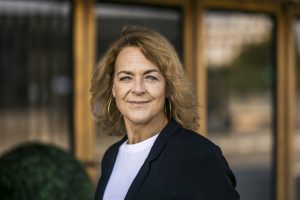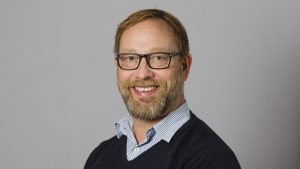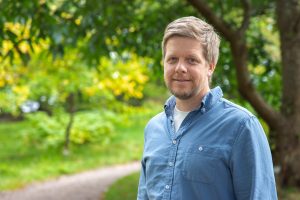
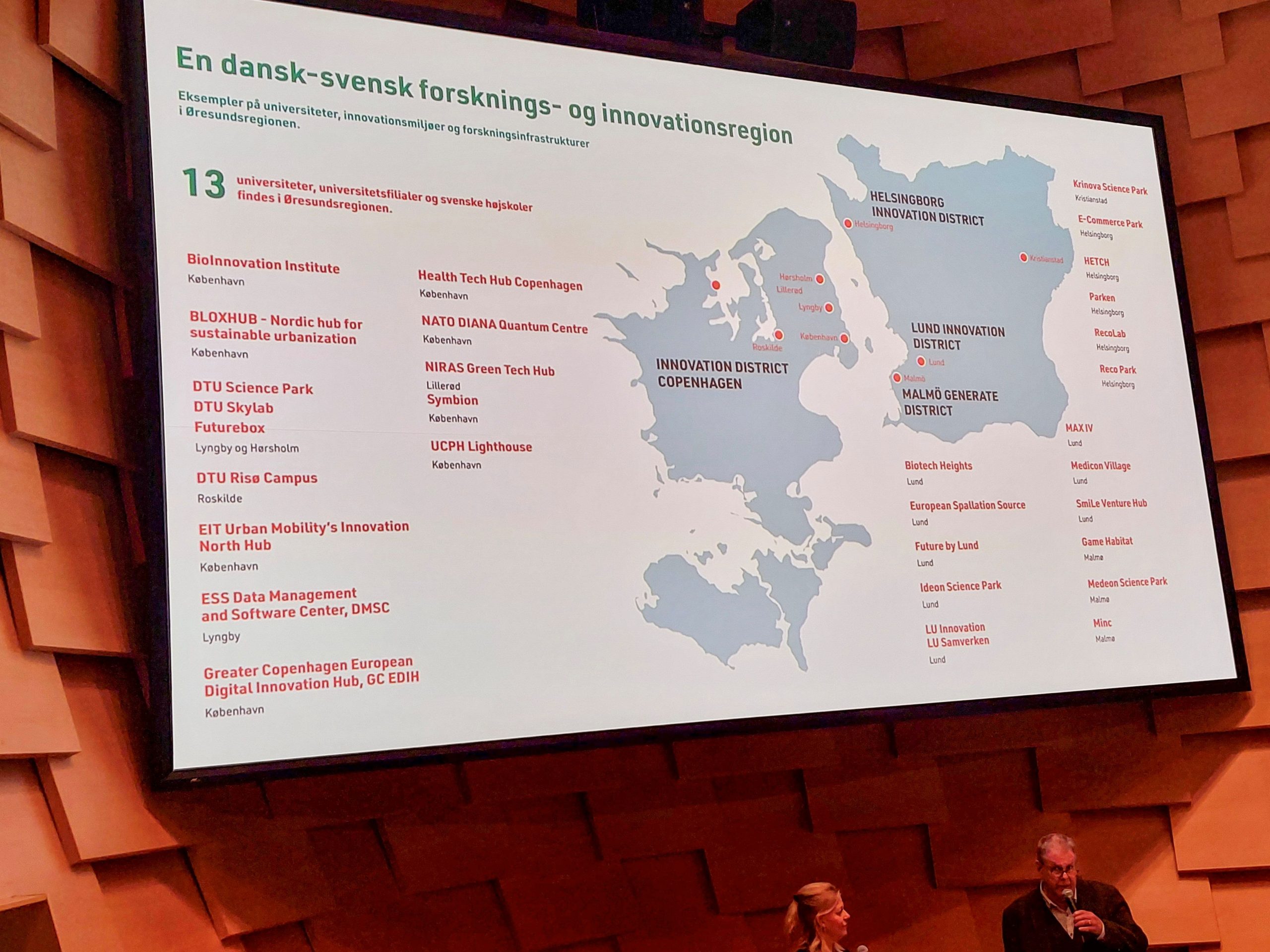
“Zoom out instead of studying case by case. That’s when you see the full picture of the innovation system in the Öresund region and it becomes evident that one plus one is greater than two,” says Petter Hartman, director of Medicon Village Innovation in Lund.
Read this article in Swedish on Arbeidsliv i Norden
This is a facility where companies and the city’s university conduct research, and where a total of 2,800 people across various operations work with a shared focus – solving health challenges.
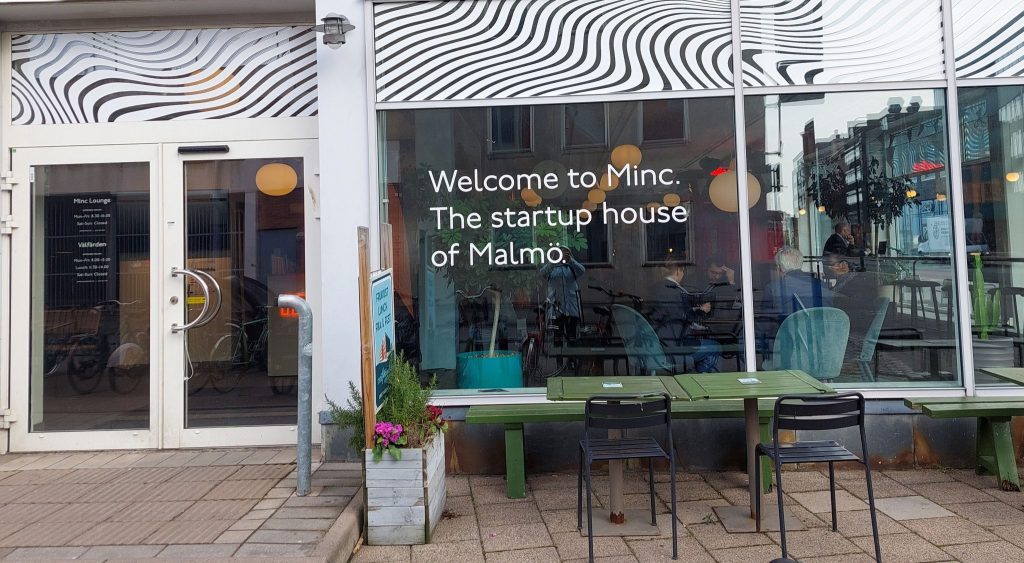
The Nordic Labour Journal meets Petter Hartman at Minc, an incubator for startups and entrepreneurs which has been run by the City of Malmö since 2002. We will come back to this.
It is the day after a Danish-Swedish innovation day in Ørestad, organised by Ørestad Innovation City Copenhagen and Øresundsinstituttet where a range of players and representatives from Danish and Swedish universities, innovation clusters and research, startups and long-established companies discussed how to further develop cooperation across Öresund.
The train journey from Malmö central station across the Öresund Bridge to Ørestad takes 30 minutes.
Access to a Nordic capital is crucial
Petter Hartman’s role as director of Medicon Village is to develop the facility and to foster connections between researchers and companies so they can succeed.
“We would very much like to attract more international talents to our region. The physical proximity to Denmark and especially Copenhagen Airport as a gateway to the world is crucial.”
Copenhagen Kastrup is the largest airport in the Nordic region in terms of passenger numbers. The train journey from there to Lund takes 37 minutes.
Another determining factor for Medicon Village’s development is its location in the Öresund region as part of Medicon Valley, one of Europe’s largest life science clusters, believes Petter Hartman, who points out the advantages this offers jobseekers across the sector.
“New graduates from Lund University can start their career in Denmark in a global environment with a large corporate mindset, and Danes can come across to take CEO roles and research positions in companies in Skåne.
“It’s a give-and-take but can also be viewed from two different perspectives – that Denmark is taking our Swedish workforce, or that Swedes who’ve grown tired of commuting return with valuable knowledge, contacts and international experience.”
Innovation across borders
During the innovation day, several of the speakers agreed on the need for more “Coffee Connections” – despite digitalisation – meaning more physical meetings are needed across Öresund between people who are involved in the region’s innovation development.
It was during such a physical meeting that Minc’s chair, Jonas Michanek, bumped into Anne-Louise Thon-Jensen, innovator plus partner and founder of Danish SDG Invest and Vår Ventures. Their meeting led to her joining Minc’s board in 2023.
“While the capacity for innovation is great on both sides of the sound, there is a need for more integrated cooperation between the countries.
“This can be achieved through shared testing environments and regulatory frameworks, as well as more coordinated capital,” she tells the Nordic Labour Journal.
Minc takes a broader geographical perspective, and Sweden and Denmark are therefore viewed as a single region, both in terms of infrastructure and the business sphere.
“We keep our doors open for Danish entrepreneurs and investors and would love to see Sweden and Denmark turn into a joined-up innovation system.
“Today we operate more in parallel than having a deeper cooperation on skills and data. In a global context, this would be a strategic advantage for the entire Öresund region,” says Anne-Louise Thon-Jensen.
From Malmö to the world
The Nordic Labour Journal also meets Philippe Höij at Minc. He is the CEO of DFRNT, a company he founded in 2022. DFRNT has had their headquarters at the Malmö incubator since 2023.
DFRNT’s business idea is to use global standards to transform the field of financial management by establishing traceable mathematical and logical rules within verified networks, so that all information can be easily used for different types of reporting.
They also aim to ensure that all business information is ready to be handled by AI in regulated industries, as it is linked to standardised taxonomies.
“Today, it is difficult to link data across business systems in a reliable way. Companies can incur fines because they are unable to demonstrate how their information has been compiled into reports and into financial and non-financial data.
“Our system continuously verifies that all information is consistent and makes it easy to view different levels of detail in different dimensions. With our system, it’s impossible to make errors without them becoming visible,” says Philippe Höij.
In practical terms, DFRNT wants to enable efficient communication of business information both between people and between humans and machines by applying standards.
It is no coincidence that they placed the company at Minc in Malmö, explains Philippe Höij.
“Minc is one of Europe’s best incubators. They offer high quality support for startups that want to scale up and achieve global reach. We have participated in the accelerator programme twice, and one of the results has been securing investors in both Sweden and the USA.”
Right now, the company has seven employees. Two live in Sweden while the others come from Denmark, Germany and Switzerland.
“DFRNT operate in a global market, so we need diversity in our workforce. Not least because of the new Fehmarn Belt connection that will open in a few years and bring Hamburg closer,” says Philippe Höij.
The new connection will mean a train journey between Malmö and Hamburg will only take around three hours.
The company has already moved across the Swedish border. Since last year, DFRNT has had an office in Copenhagen, at Copenhagen Fintech, a Nordic centre for financial technology.
“I often travel across the sound to meet other entrepreneurs and mentors at Copenhagen Fintech together with our colleagues,” says Philippe Höoij.
Choosing the Danish capital over Stockholm was a “natural choice” as he puts it.
“It is considerably shorter to commute to Copenhagen. The train journey there from Lund where I live takes less than one hour.
“The train to Stockholm takes much longer and I also can’t work during the two ours it takes to travel through Småland, where the internet connection is far too slow or non-existent.”
While the office in Denmark means opportunities for the company, there are also administrative challenges and issues with the other country’s different regulations.
“In a digital age, it should be possible to eliminate much of the administrative complexity. Why not set up a fictitious company that operates across Öresund and run a test to see what needs to be put into system and solved?”
Philippe Höij also calls for improved cooperation between top politicians in the Öresund region and wants them to try to gain a better understanding of what it is like to be an entrepreneur on both sides of the Öresund, and also to prepare for Greater Greater Copenhagen.
Integration in the Öresund region – an unfulfilled process?
Physical meetings over coffee and cake helps strengthen innovation capacity and competitiveness in the Öresund region, as noted by the participants at the innovation day. But other factors can impact developments too.
Here, as at other times when Danish-Swedish integration being debated, calls were raised for improved and cheaper transport links across the Öresund and also the need for a second fixed connection between Denmark and Sweden.
[Editorial note: A recent Swedish government inquiry has proposed that the two countries jointly examine the need for such a link.]
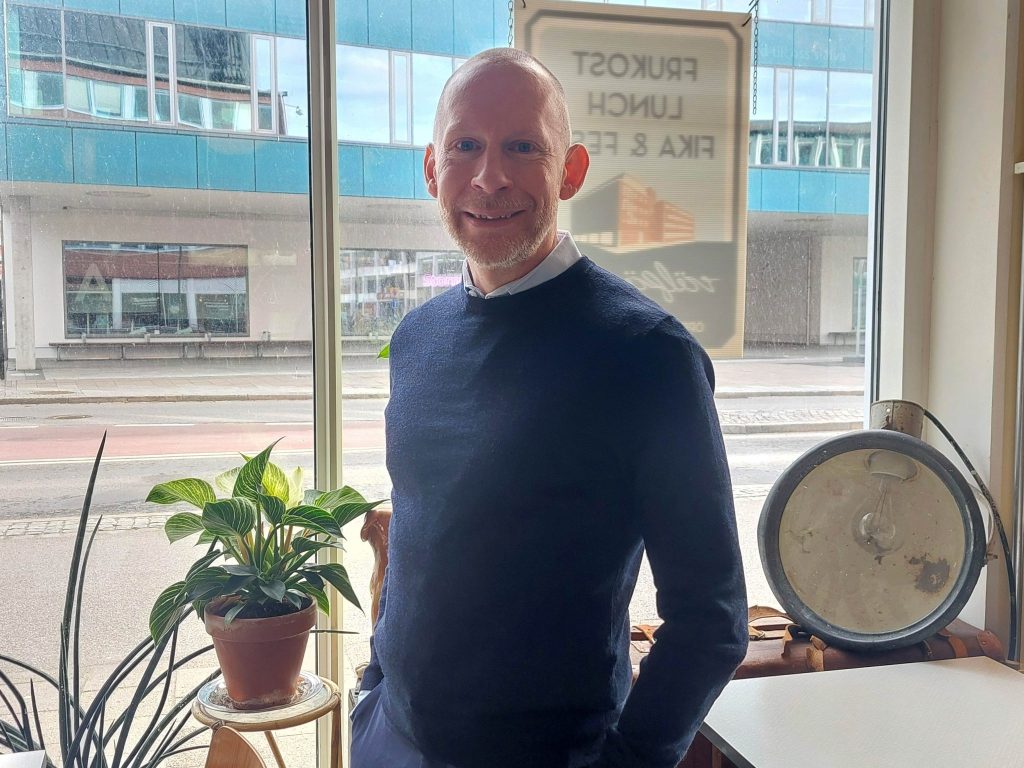
“Working across a national border is both complicated and fairly expensive,” says Petter Hartman, who has his own experience of commuting across the sound.
“I travelled from my home in Sweden to work in Denmark for 12 years. For eight of those years, I was an employer for an organisation that had a few Swedish employees.
“When I worked for Medicon Valley Alliance, I represented life science and biotech companies in the Öresund region and brought an industry perspective with cross-border interaction.”
These experiences as a cross-border commuter in different roles leads him to conclude that there is a lack of understanding of what exists on “the other side” and the opportunities available there.
This is something Øresunddirekt helps to address by providing public information from authorities to both residents and businesses in the Öresund region, says Petter Hartman.
Another challenge to increased integration between the Nordic countries is the classic border barriers, where some disappear while others emerge when EU legislation is implemented in two countries.
Also, the national perspective does not benefit integration, and therefore not the Öresund region as a driver of growth, points out Petter Hartman.
“There is a strong will regionally, but it is not the Skåne region and its municipalities that can make the decisions needed to remove the problems. This means there are limitations to how far you can get with integration.
“And this is despite the fact that the Öresund region enjoys a special position within the EU. Our research infrastructure and academic education opportunities result in a well-educated workforce and strong conditions for becoming an even more competitive region,” he says.
Well-trodden path can become motorway
If border barriers were removed, Danish and Swedish innovation would have a greater international impact, believes Petter Hartman. He adds that there is a need for earmarked Nordic funding for research and development.
“Today, you can only apply for small amounts, and you should not be solely dependent on EU funding for research collaboration. The Swedish government needs to send a signal that we want to cooperate with Denmark. Then the path we have trodden could become a motorway, something intentional and not accidental.
“If we can make it work, the results will be amplified. Both research and companies could accelerate. This is about acting together as a unified force.
“Major investments like ESS would never have ended up in Lund if Denmark and Sweden had not done exactly that,” says Petter Hartman.
ESS
– stands for European Spallation Source.
“Sweden and Denmark are the host countries of the ESS, which is a European research infrastructure consortium, the European Research Infrastructure Consortium (ERIC). The member countries are from across Europe,” writes Lund University.