

The report “Nordic Economic Policy Review 2026: Advancing Policy Through Randomised Experiments” does a deep dive into what is actually needed to carry out this type of large-scale trial, from practical design choices to political and ethical considerations.
Read this article in Norwegian in Arbeidsliv i Norden
The launch took place in Oslo on 6 May, organised by Nordregio on behalf of the Nordic Council of Ministers in cooperation with the Norwegian Ministry of Finance.
Researchers and decision-makers shared their experiences from Nordic experiments and reflected on what such studies can – and cannot – say about future economic policies.
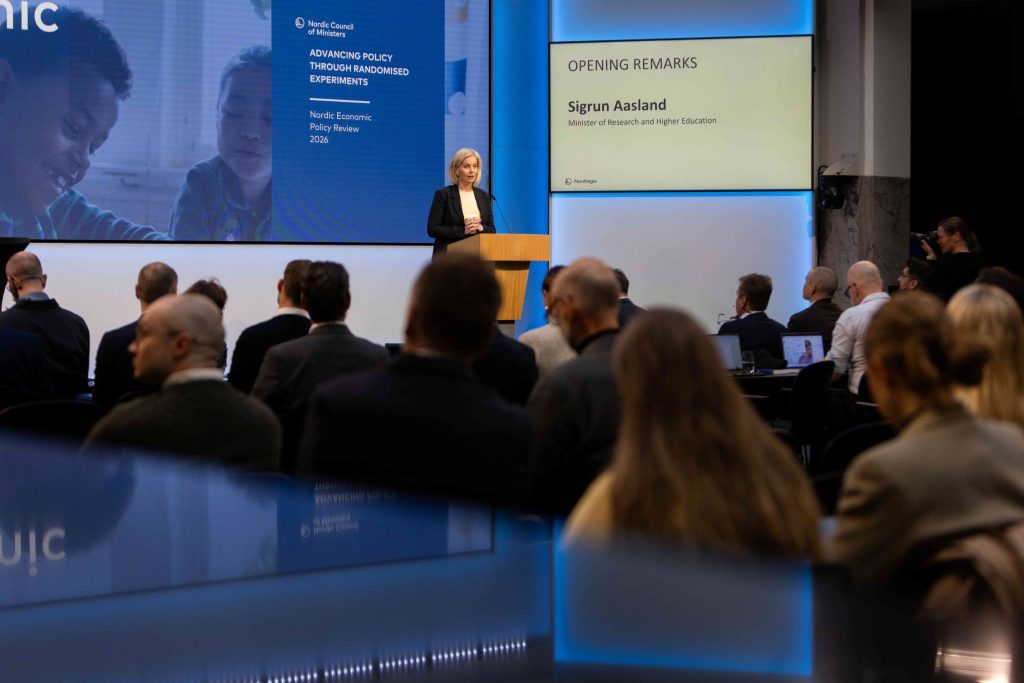
Norway’s Minister of Research and Higher Education Sigrun Aasland opened the event.
“Politics is about people.
“Good policymaking must take into account the complexity of human behaviour and the choices we make,” she says.
But such choices do not occur in controlled environments.
“We don’t live in labs, and we cannot test policies in labs in the same way either.”
That is exactly why randomised trials are interesting, she argues, because they make it possible to study how measures actually work in society and can provide a better basis for decision-making. Yet she also points out that such trials involve both legal and ethical dilemmas.
Karen Ellemann, the Secretary General of the Nordic Council of Ministers was also present during the launch.
She considers the report’s theme to be both topical and very important.
“Randomised trials allow us to test policies in real life before measures are rolled out on a large scale.
“They help us distinguish between what we think works and what actually does. There are big benefits from getting policies right from the start, not just economically, but socially as well.”

Useful tool
The report’s main conclusion is that randomised controlled trials (RCTs) are a useful tool for finding out whether policies actually work.
It points out that the Nordic countries have an advantage through their access to comprehensive register data, which makes it possible to follow large population groups over time.
Randomised controlled trial (RCT)
A scientific experimental method to investigate the effect of a treatment or intervention, often considered to be the “gold standard” in medical research.
Participants are equally assigned (randomised) to either a treatment group or a control group to ensure comparable groups.
Randomisation: Participants are randomly allocated to groups, which minimises bias and distributes external factors evenly.
Control group: One group receives the treatment while another (the control group) receives standard treatment or a placebo.
Purpose: To establish causal relationships and measure the effect of an intervention.
Hierarchy: RCT studies are highly ranked in the evidence hierarchy for evaluating the effect of interventions.
(Sources: The Norwegian Electronic Health Library, Store norske leksikon)
The report also emphasises that such trials are much more than a technical exercise. Legal framework, ethical considerations, equal treatment, political legitimacy, implementation, costs and transferability raise challenging questions.
It recommends not to “randomise everything” but to use randomisation where it will clearly lead to better insight compared to the alternatives, while creating institutions that make the trials ethically, legally and practically robust.
Roope Uusitalo, professor at the University of Helsinki, is the editor of this year’s edition of “Nordic Economic Policy Review”.
He believes the Nordic region is particularly well placed for carrying out randomised trials, partly because of strong institutions, high quality register data and high levels of trust in evidence-based policymaking.
Yet he also underlines that such studies are not straightforward.
They often require adjustments to legislation, careful ethical assessments and the political will to see them through.

Controversial Norwegian trial
Back to the beginning: What Norwegian media often call a “tax lottery” is not a lottery.
In short, it concerns a government trial to see whether lower taxes can encourage young people to work more. This is done through a scheme offering an earned income tax allowance for young people.
When Minister of Finance Jens Stoltenberg launched the proposal for an extraordinary tax allowance, he pointed out that many people see little financial gain from moving from benefits into paid work.
“This kind of trial can give us knowledge of how the tax system can supplement other measures aimed at getting more into work and create a basis for perhaps considering a permanent solution,” Stoltenberg said.
The trial has randomly selected around 100 000 young people aged 20 to 35 who will get the allowance – around 8 per cent of the cohort. Participation is decided by a draw, but not everyone will get the full allowance as it depends on income.
The maximum tax reduction is 27 500 kroner annually (€2,540), and the scheme applies to incomes between approximately 125 000 kroner (€11,540) to 657 000 kroner (€60,700).
The trial is set to last for five years at an estimated costs of 500 million kroner (€46,175,000) in annual lost tax revenue.
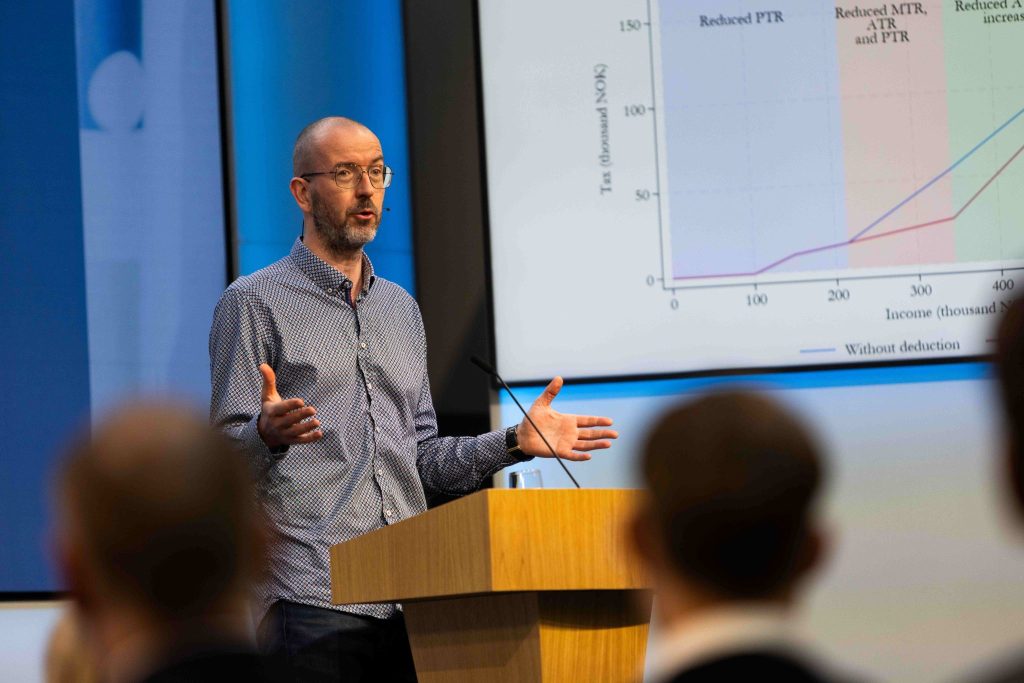
Researchers from the Frisch Centre and Norwegian Fiscal Studies at the University of Oslo are following the trial closely.
Simen Markussen, Director at the Frisch Centre, has written the report’s chapter about the experiment together with Marie Bjørneby form the Ministry of Finance. He calls it unusually comprehensive.
“This is one of the largest social economy research projects in our time.”
Created noise
The trial has garnered substantial attention and created debate. That is not surprising, argues Simen Markussen.
“It’s unusual to carry out a trial at such a large scale, and particularly involving taxation,” he says.
Markussen points out that the trial also challenges fundamental principles in the tax system.
“The participants could benefit economically. This is in breach with the principal of equal income, equal taxation. That naturally creates reactions.”
Norwegian LO sceptical to “tax experiment”
The Norwegian Confederation of Trade Unions (LO) believes the “tax lottery” is poorly targeted, costly and an experiment that is in breach of the principle of equal treatment, which can lead to greater inequalities – while its economic effect remains uncertain.
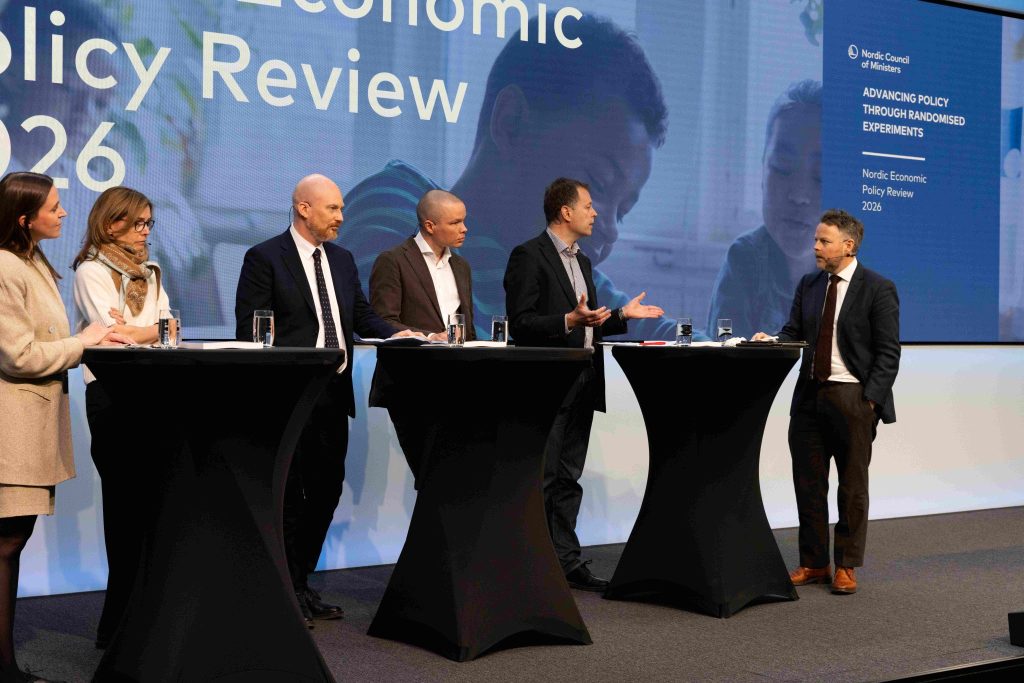
This scepticism was repeated during the panel debate at the report launch. The panel included Karen Ulltveit Moe (Oslo University, Norway), Jukka Mattila (VATT Institute for Economic Research), Oda Indgaard (the Green Party Norway), Thomas Eisensee (the National Institute of Economic Research in Sweden) and Ragnar Bøe Elgsaas (LO Norway).
The debate raised issues like when is the use of a trial justified? Who bears the cost and who receives the benefits? And how to you weigh up the need for knowledge against considerations of fairness and political legitimacy?
“This is a very expensive trial. The question is whether it is the best way to spend this money,” Ragnar Bøe Elgsaas tells the Nordic Labour Journal after the debate.
“If the goal is to get more people into work, we have to ask: Is this the most efficient tool? Or are there other measures that bring better results?”
He questions whether tax incentives are the best way of doing things.
“Does reduce taxes actually get people into jobs? Or should we invest more resources in close follow up and individual measures?”
As an example, he mentions a Norwegian low-cost measure, also mentioned in the report, where young unemployed people were given online follow up linked to goals around sleep, exercise and substance use.
The results were clear: After twelve months, the probability of being in work was 7 percentage points higher, while the share receiving unemployment benefits was 5 percentage points lower.
“This is about someone seeing you, following you up and setting expectations. I have more belief in such measures than the tax experiment,” says Bøe Elgsaas.
He also sees the debate in itself as important.
“It being controversial is really as expected. It’s good that we have a public debate about these types of measures.”
Some of the opposition is also focused on the policy instrument itself: the earned income tax allowance.
“Some believe it won’t have much of an effect. Others are critical because they see it as an indirect cut in welfare benefits. Both objections are legitimate,” says Markussen.
But when it comes to the effect, he underlines that the evidence base is weak.
“Much of the discussion is based on presumptions. We simply don’t know what the effect is. That’s exactly why we are performing this trial.”
He also points out that some argue the opposite.
“Some are so certain the measure works, that they don’t see the need to test it.”
Big project, small effect?
The size of the project is not a coincidence.
To be able to measure the effect with enough precision, you need to have many participants, explains Markussen.
“We have carried out calculations in advance to find out how big the trial has to be. When we expect relatively small effects, we need a large dataset in order to be able to draw reliable conclusions.”
The size of the allowance itself is important.
“The allowance is quite substantial. This increases the possibility that we will actually be able to measure an effect.
Yet expectations are moderate.
“We estimate an employment effect of around 0.8 per cent. This is not especially high, and it could also end up being lower.”
Experiences from other countries provide limited direction.
“In Sweden, the earned income tax allowance was introduced for everyone at the same time. You then have no control group which makes it very difficult to measure the effect,” he says.
Markussen believes there is a lot to gain from looking at what is being done in terms of similar trials in other Nordic countries.
“We have already learned a lot from each other. One of the things we’ve looked at during this project is Finland’s basic income trial. This gave us an important basis for several of the assessments we did here in Norway.”
More Nordic examples
In addition to the chapter on the Norwegian trial, the report consists of several examples from Nordic countries:
A Finnish kindergarten trial, a review of RCTs in labour market policy, a Danish meta-analysis of measures aimed at children and young people, and a Finnish trial of recruitment support for small businesses.
All together, these contributions show that RCTs often provide more credible evidence than traditional evaluations. The report also points out that null findings, low participation rates and practical implementation challenges can be equally important learning points as positive effects.
Johan Vikström, professor of economics at Uppsala university, is behind the chapter on active labour market policy.
He demonstrates how RCTs can be particularly useful when evaluating measures like job seeker courses, follow-up support, control regimes, the use of private providers, wage subsidies and various behavioural interventions.
A key problem when you do not have randomisation is selection, he points out.
Participants in a programme may differ systematically from those who are not taking part. It could lead to effects being wrongly attributed to the intervention when they in reality are caused by differences in motivation, health, skills or the caseworker’s assessments.