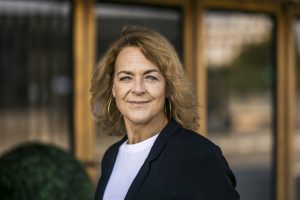

The Stendur leader says that their clients are sent to them through VIRK, a national vocational rehabilitation fund, and through the municipalities.
The type of people who need rehabilitation has changed since the centre opened 20 years ago.
“When we started, our biggest group of clients were women in their 40s and 50s, who had plenty of time left of their working life but for some reason had lost their place in the labour market and really wanted to make changes to their lives and get back in.
Read this article in Norwegian on Arbeidsliv i Norden
“Today, the main focus is on young people, whose number in need of rehabilitation has grown significantly.”
Jóhannsdóttir says this creates other kinds of challenges.
“We are getting people as young as 18 who have very few jobs on their CV, if any. So the question is: What are we really rehabilitating? This is a change we are seeing.
“Often, but not in all cases, these are individuals who have had a hard time in primary school, even though they got good grades. Their problem is psychosocial – it can be physical, mental, social or a mix of it all.
“So we get people who did not feel good in primary school, dropped out of high school and have not been able to find their feet in the labour market.”
A tough labour market
When asked why this group is getting bigger now, Jóhannsdóttir says that even though there has been an emphasis on early intervention, little has been done in some cases.
“The problem has been growing for some time without intervention, and then it becomes bigger. And when you have no interest in education, and you don’t feel good, you often don’t find your place in the labour market.
“What is more, the labour market is tough. You have to be able to show up on time and fulfil certain demands – simply having the will to work. But what kind of jobs can you get when you don’t have any education or capabilities that are of some commercial value?”
A common problem with this group is that they simply don not know what they want to do for a living, or in life.
“When you don’t know what you want to do, you’re at risk of increasing isolation. You get stuck in your room, for example watching TV shows or playing computer games. If you get a job where you are constantly showing up late, you lose it.
“Some people in school fail to attend even though they really want to be in there – they simply have other problems that cause them not to show up, sometimes because of mental illness or they don’t have enough self-belief.”
Therefore, vocational rehabilitation can also include helping people find an education that interests them.
“Many people need more support than the school system can offer. But at the same time, the supply of educational choices has never been better than today.
“And despite this, we have this group that is not interested in education but also can’t find their feet in the labour market. So during rehabilitation, our aim is that the individual either finds work or starts an education.”
Jóhannsdóttir says it can be challenging for individuals who have been isolated for years to start rehabilitation in a group. Some have developed social anxiety.
Focus on routine
Most rehabilitation programs run every weekday from 9 to 12. This can be courses in everything from painting to finances.
“This in itself can be a challenge for people who have turned their living routine upside down, and also have to make other changes in their daily lives. We try to offer each group the courses we believe are consistent with their needs.
“We supervise most of the courses ourselves, but if it needs expertise we don’t have, we find the experts we need.”
There are also selective courses in the afternoon or counselling from experts such as a psychologist, nutritionist or alcohol counsellor.
People have different goals. Some want to get support for a certain education or expertise, while others simply want to figure out what they want to do.
“With the latter group, we say: You are in control. It’s like when you’re playing handball. We have the players who score the goals, but the coach is on the sidelines trying to push the players in the right direction and provide necessary coaching.
“In our case, we are the coach, but the individual is the star player in their life and has to score the goals. So we can say: In order to keep a job, you have to train yourself to show up on time. And that can be a challenge for many people.”
Jóhannsdóttir says that many of the people who have participated in the rehabilitation programmes say one of their big takeaways was that they were treated with respect. And that also means they have to show tolerance towards others.
“Here, people get to be who they are, and we help them to find their feet and what direction they want their life to take.”
Tolerance needed from the labour market
Yet it is also necessary for the labour market to show some tolerance, as it can be tough on those who do not show up on time.
“It is beneficial to society when as many as possible can work. That is what vocational rehabilitation is all about, to find the strengths in people who have mental, physical or social problems, and then to work on that.
“That also includes people who perhaps can only work part-time, at least for the time being.”
Therefore, contracts are made with companies to train an individual while they work temporarily without pay. Then that employee can be hired as soon as they are ready for it. They can work up to 65 per cent in paid employment and be in rehabilitation at the same time.
Jóhannsdóttir says part of the problem is that people can earn more from benefits than from the lowest-paid jobs.
“But we also see people on benefits who come for rehabilitation because they want to participate in society. So a big part of it is to have a purpose in life. And one of the groups at risk here is young men.
“Suicide rates among this group have increased, and that’s not because they have problems supporting themselves financially. It’s often because they didn’t find a purpose in life while not participating in the community.
“So companies need to be open to hiring employees with a reduced capacity to work, and also people who are gradually increasing their work capabilities.”
The program has seen good results. In 2024, 65 per cent of those in rehabilitation ended up either working or in education, and around 30 per cent continued their rehabilitation.
“It is clear that it pays to invest in vocational rehabilitation. We are happy with what we are achieving.”