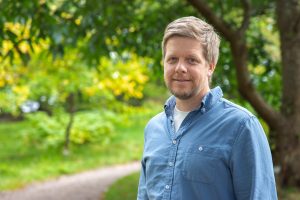
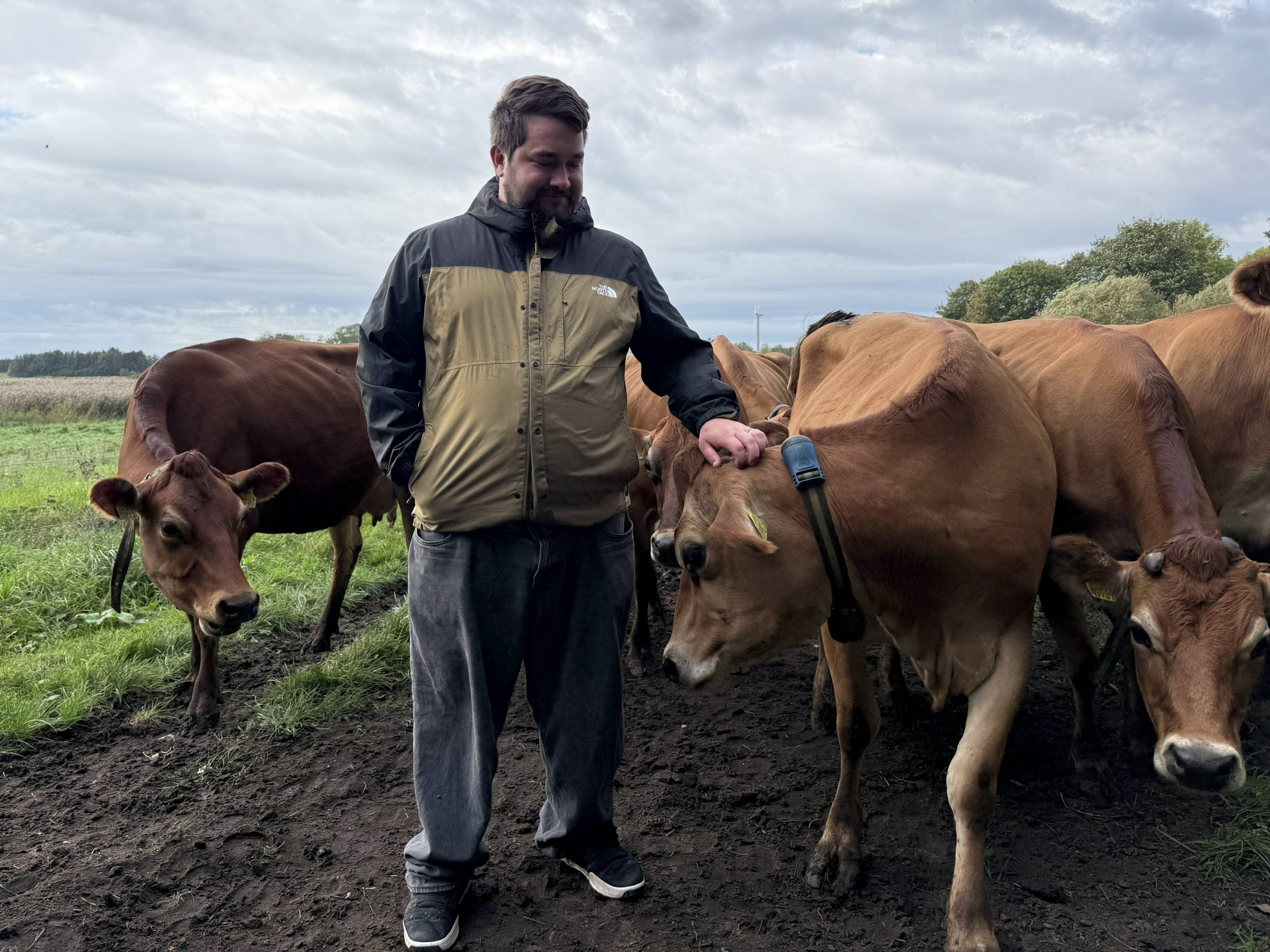
When some 120 Jersey cows and rearing calves at Svanholm Gods west of Copenhagen come into heat, farmer Mikkel Brandstrup Jørgensen gets alerted from the cows’ activity-monitoring collars.
Read the article in Danish on Arbeidsliv i Norden
Ten years ago, he had to go around shining a torch into each cow’s rear end to asses whether she was ready for insemination.
“Our breeding programme has become more efficient because I know precisely when it is the best time to inseminate each individual cow. With help from AI, I get a report on my screen whenever I ask for it.”
AI also tells Mikkel Brandstrup Jørgensen much earlier when a cow is ill.
“I used to have to go out into the cowshed or the field to discover a sick cow. Now, data appears on my screen to show if a cow behaves in a way that could indicate an illness. That means we can start treating her sooner.”
Fewer farmers
Easy access to AI-generated summaries saves Mikkel Brandstrup Jørgensen time. He also feels this makes farm operations more efficient. On the other hand, he spends more time on his computer.
That was definitely not part of the plan when he, aged 14, chose to become a farmer, he says.
“I have ADHD and find it hard to sit still, so for me, it’s been fantastic to have a job in the cowshed, in nature and in close contact with animals. Spending more time in the office and less time with the animals is not a development that appeals to me.”
He predicts that AI will make many farming jobs redundant and that vacancies in farming will increasingly be filled by people with very different skills and backgrounds than before.
“I have met many working in agriculture who have diagnoses like my own who are happy and very good farmers because the job has been very practical and not dependent on spending many hours at a desk in front of a screen.
“Where will they find jobs if being a farmer in future will to a large extent be an office and programming job?”
Mikkel Brandstrup Jørgensen has had quite a few young people on work placements in his cowshed.
He has seen how youths who do not consider themselves to be academically inclined can gain the confidence to pursue further training after working on a farm and discovering that a qualification in agriculture can lead to meaningful work outdoors, in nature and caring for animals.
“That’s what it was like for me. I wasn’t great in school, but because I was motivated to study to become a farmer, I managed to get good grades.”
AI removes weeds
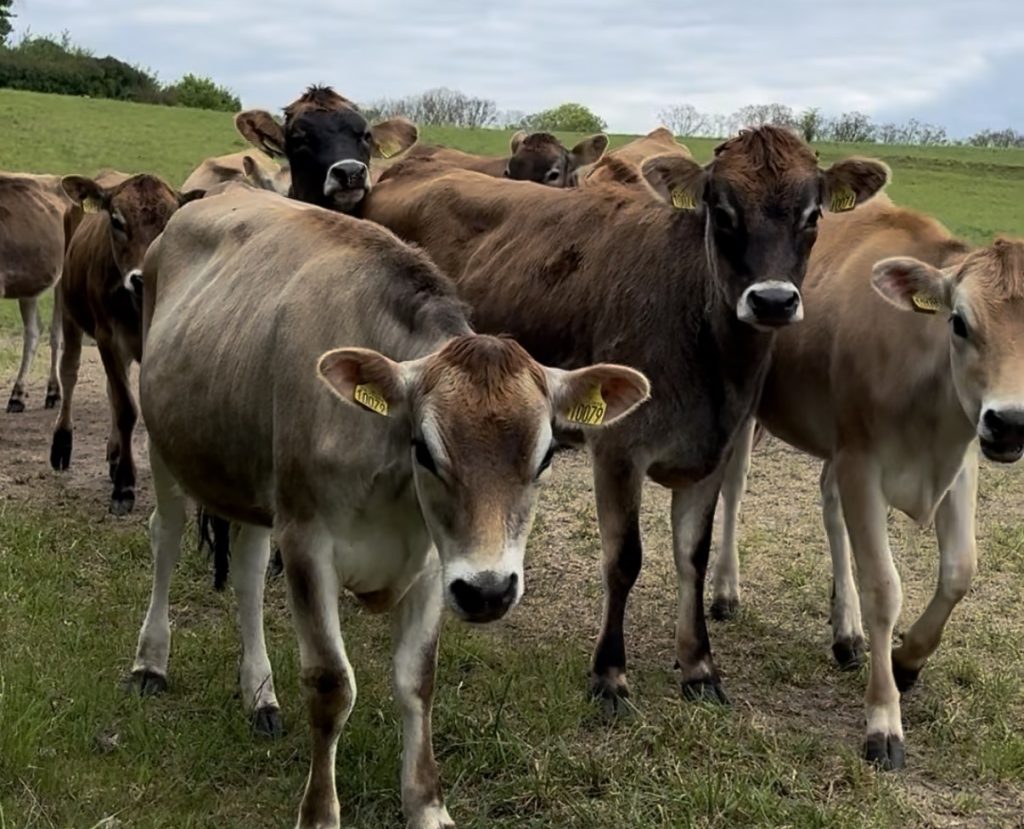
Svanholm Estate is an organic farm an hour’s drive west of Copenhagen, producing both milk and crops.
Peter Vingum, an organic farming adviser at Velas, Denmark’s largest agricultural consultancy, believes AI offers enormous potential for Svanholm and other arable farms.
“AI is used a lot in agriculture to control weeds in the field, and there are major economic and environmental advantages to doing this,” says Peter Vingum.
He explains that pesticide use among conventional, non-organic farmers can be cut by 50 to 80 per cent when they use AI to spot weeds in the fields.
In practice, a drone takes pictures of the farmer’s fields. The high resolution images allow you to clearly see the leaves’ structure and colour. Using AI, weeds in the pictures can be identified and AI can also create a map of the field and a detailed treatment plan.
This means the farmer can spray very precisely, using exactly the type and amount of pesticide needed to kill the weeds.
There are also now robots that can drive around in the fields and mechanically remove weeds or use light to kill them, based on an AI-generated field treatment map, explains Peter Vingum.
This technological solution is used by organic arable farmers, among others, who are not permitted to use pesticides on their fields. AI-assisted robotic technology is not currently used at Svanholm Estate.
New forms of advice
Peter Vingum is one of Velas’ crop production specialists who can give advice on the opportunities new technology can bring. He sees enormous potential in using AI to analyse standardised data across different farms. However, he believes this is still some way off.
“AI is perfect for recognising patterns in data, and there is a lot of data, but we still don’t have a model for how to gather that data across different farms.”
He believes a lot of farmers are already using AI but that few of them dare trust it 100 per cent.
For quite some time to come, they will still need to pay for advice from agricultural consultants who visit their farms and inspect fields and livestock together with the farmers, Vingum predicts.
“Some farmers think that ‘I can just ask AI about that’, but sorting through the information produced by AI can be overwhelming and very time-consuming for the farmers, especially if they also want to spend time working on the farm.
AI’s ability only to give answers to what the farmer asks is also a weakness, as well as the fact that AI often provides answers that pleases the person asking, continues Peter Vingum.
“An experienced agricultural consultant will notice and point out aspects of the farm’s operations that the farmer might not be aware of, and the consultant will tell the farmer whether he or she is wrong. AI won’t.”
AI could also have a huge impact internally in agricultural consultancy firms, predicts Peter Vingum. A large part of the consultants’ work is to help famers document their operations and to apply for funding through various support schemes.
These are routine administrative tasks that involve a lot of paperwork, which consultancy firms can solve faster when using AI.
AI can also help agricultural consultants like Peter Vingum stay on top of the many changes to EU legislation, national regulations and official guidance.
“AI is a powerful tool that we agricultural consultants can benefit greatly from in the future.”
Historic transition
Danish agriculture is on the threshold of the greatest green transition ever. Agricultural land is to be converted into natural habitats, and farmers will face new restrictions on nitrogen emissions as part of the Green Tripartite agreement.
This is a political agreement described by the Ministry of Nature and Animal Welfare as “one of the most ambitious green agreements in Danish history”.
The Green Tripartite agreement
An agreement to create more natural habitats, cleaner water and a sustainable transition in agriculture.
One of the most ambitious green agreements in Danish history, designed to deliver environmental improvements and ensure that Denmark remains a frontrunner in the green transition.
- 250,000 hectares of new forest.
- 140,000 hectares of low-lying agricultural land to be converted into natural habitats.
- Greater biodiversity, helped by establishing new national nature parks and improving the marine environment, including Danish fjords.
- A carbon tax on livestock production. Denmark will become the first country in the world to introduce this type of tax.
- A forward-looking, competitive and sustainable Danish food industry, with greater emphasis on bio-based solutions, climate technologies and plant-based foods.
- 43 billion Danish kroner (€ 5.75bn) to convert agricultural land into forests and natural habitats.
- Local partnerships between municipalities, central government, environmental organisations and agricultural organisations to convert farmland into natural habitats.
Source: Danish Ministry of Nature and Animal Welfare
Morten Winther Vestenaa is a senior adviser at the Innovation Centre for Organic Farming. He is involved in several research and advisory projects aimed at helping agricultural consultants advise farmers on the new nitrogen regulations and the conversion of farmland into natural habitats.
New software tools have to be developed to perform this work, and for this task, AI is “completely revolutionary” believes Morten Winther Vestenaa.
At the innovation centre, he and his colleagues also use AI to create training exercises in which consultants advise AI farmers, helping them prepare for the new role they will take on as a result of the requirements set out in the Green Tripartite agreement.
New AI solutions
AI and related data-driven technologies will be essential for the success of the Green Tripartite agreement, believes Nicolai Fog Hansen, head of the Applied Data Intelligence section at the Danish Technological Institute, an independent, non-profit research and development organisation.
He is the programme director of GATE, a three year project aimed at creating a single point of access to data giving agriculture’s stakeholders a better foundation for developing more and better data-driven tools.
“The Green Tripartite agreement aims to bring farming into better balance with nature, with more ambitious targets than before.
“This will require more research, innovation and the introduction of new solutions in agriculture, including AI-driven technologies that can support more sustainable decisions on issues such as fertiliser use, pesticides and biodiversity.”
Nordic cooperation
Nicolai Fog Hansen believes that Danish agriculture is well positioned to create good AI solutions as it has access to a lot of good-quality data and because farmers are happy to use AI when they see that it brings results.
‘When farmers see that collars fitted to their cattle improves breeding and that AI makes weed control more efficient, they become more motivated to ensure their data is accurate.
“And when the farmers’ data is shared with us, it gives us a very precise datasets that can be applied in models used to regulate things like nitrogen emissions.”
Nicolai Fog Hansen expects AI solutions will make it easier for more stakeholders to come up with and offer good solutions for agriculture.
“AI opens up for more innovation because you don’t need big, capital-intensive companies to develop new AI solutions.
“Small companies anywhere in the world can for instance create algorithms similar to the one used to detect when a cow is in heat, which can be incorporated into a device fitted to the animal.”
Nicolai Fog Hansen sees great potential for this type of innovation in the Nordic countries, where research institutions are already collaborating across borders to support the digital transformation of agriculture. The Nordic Testbed Network is a good example, he says.
It develops knowledge and technology to support the digital transformation in agriculture, forestry and aquaculture in the Nordic and Baltic countries.
The network organises virtual and physical meetings between researchers and companies across the Nordic countries, and Nicolai Fogh Hansen says he has benefited greatly from participating in several of them.
“It’s a good initiative. Small steps like these are needed to increase cooperation across the Nordic region on the ongoing digital transformation in agriculture, and there is a lot we can learn from each other in the Nordics.”
Nordic Testbed Network is administered by Nordic Forest Research (SNS), the Nordic Joint Committee for Agricultural and Food Research (NKJ) and the Nordic Council of Ministers’ working group on fisheries.
Its aim is to support test centres and testing environments as an important means of strengthening the profitability and competitiveness of the Nordic and Baltic bioeconomies.