
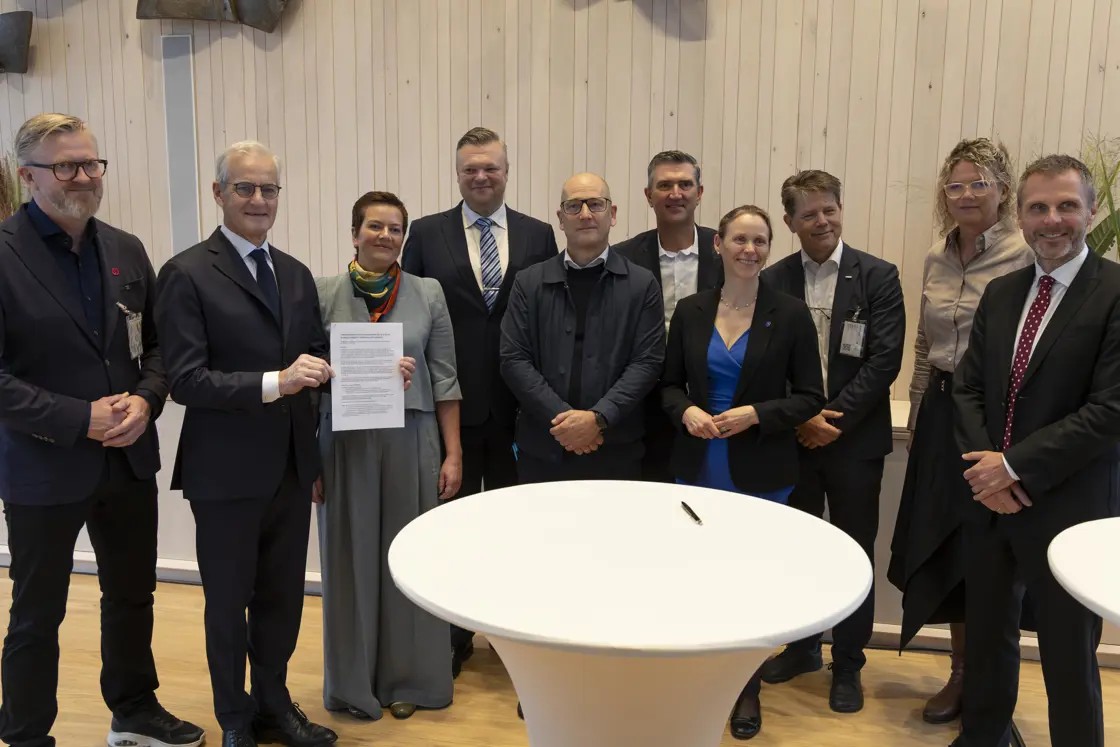
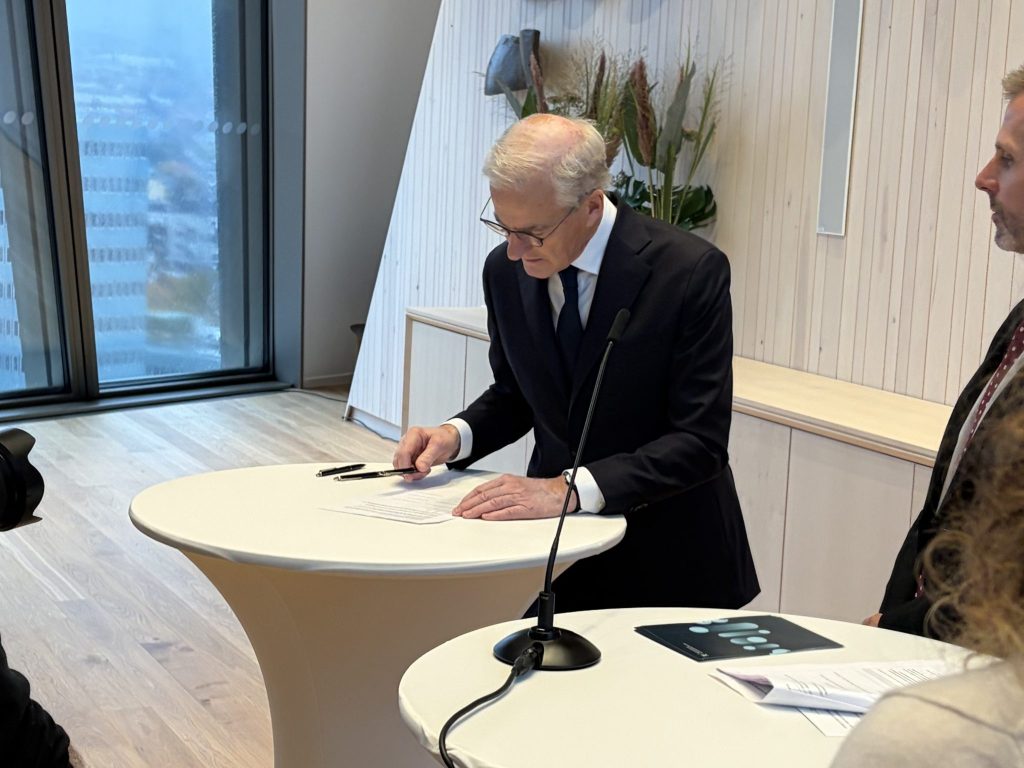
On 2 October this year, the Norwegian government, represented by the Prime Minister and the Minister of Digitalisation, signed a historic AI agreement with the eight main organisations representing employees and employers – LO, NHO, Unio, KS, Akademikerne, Virke, YS and Spekter. (You can read the original agreement in Norwegian here).
Read the article in Norwegian on Arbeidsliv i Norden
“We will continue to push for stricter controls on the most advanced AI models and also make sure artificial intelligence is adopted safely in Norwegian working life. Artificial intelligence can help us work more efficiently, create value and strengthen competitiveness.
“Through this agreement, employers, employees and authorities will find good solutions for the introduction and use of AI that also protects employees’ rights,” Prime Minister Jonas Gahr Støre said in a press release when the agreement was signed.
Foundation: The Norwegian model of working life
So even though other regulation is being discussed, and agreements are concluded in other Nordic countries, the Norwegian agreement stands out in several respects:
- Tripartite cooperation: The agreement is between the state (the authorities), employers and employees on a national level.
- Founded on the Norwegian model of working life: AI is to be introduced in line with the Working Environment Act and existing arrangements for employee participation and cooperation between employers and employees.
- A commitment to cooperation: The parties will cooperate closely to upskill employees, explore how productivity can be increased safely and responsibly, and share experience and develop knowledge on the responsible use of AI.
Union: Employee involvement is important
Employer and employee representatives welcome an agreement on artificial intelligence in working life.
“To succeed with AI in working life, the social partners and local union representatives must be included when the technology is introduced in workplaces,” says Lise Lyngsnes, President of Akademikerne (the Federation of Norwegian Professional Associations).
According to Randeberg, Akademikerne has long been working to increase employee involvement when introducing AI. Surveys have shown that involvement in the workplaces has not been good enough.
In the latest Akademikerpanelet survey in June this year, one in four people with higher education said union representatives are not being involved in the introduction of AI in the workplace.
“This is not good enough and we have to do something about it,” says Randeberg.
The Norwegian Association of Local and Regional Authorities (KS) welcomes the government’s initiative, says Odd Stangeland, first deputy chair of KS.
“As the letter of intent also states, we want to use the ‘superpower’ that is the cooperation between the social partners in order to introduce and develop AI in the municipal sector,” says Stangeland.
The AI Act sets framework for Nordic EU members
So far, there are no similar national tripartite agreements being planned in any of the other Nordic countries. Although the Nordic model is strong in these countries too, for now, they are approaching the challenges around artificial intelligence differently to Norway.
For EU members Denmark, Sweden and Finland, it is important to implement the AI Act, which sets requirements for the use of AI tools in the workplace.
Trade unions are seeking to use the new tools provided by the AI Act to secure employees’ rights, but this is happening through existing legislation and collective agreements. There are also sectoral or company-level agreements.
Sweden: Employee participation is key
The social partners in Sweden have to a large extent made use of existing collective agreements and transition agreements. This means that AI in the workplace is addressed as part of the ongoing tripartite cooperation in individual sectors.
In February 2026, the Swedish government, through the Ministry of Finance, presented Sweden’s first comprehensive AI strategy with an accompanying action plan. (Read more about the strategy in Swedish here).
The trade union movement has followed this closely and insists that employees’ skills must be safeguarded during the transition.
Employee participation is being promoted as an active strategy. The trade union movement argues that the introduction of AI tools is not merely technical upgrades but involves fundamental changes to how work is managed, organised and monitored.
Much of their argument is based on Sweden’s Co-Determination Act (Medbestämmandelagen, MBL).
The MBL requires employers to negotiate with the unions before making decisions on important changes to their operations or to employees’ working conditions.
Some in the trade union movement have been talking about the need for an MPL 2.0 which would involve union representatives before the algorithms and AI systems are purchased and implemented, to safeguard privacy, ethics and the working environment.
Unionen, Sweden’s largest union for white-collar workers in the private sector, is one example of a union with a clear AI policy. Former union president Martin Linder is fronting initiatives to show union representatives how to use employee participation strategies when AI is being introduced.
Denmark: AI guides for individual workplaces
Danish employer and employee organisations are also concerned about AI in working life. Danish trade unions are actively developing practical guidelines.
FH – the Danish Trade Union Confederation – has published a guide with specific recommendations on how AI should be introduced in Danish workplaces. (Read FH’s report in Danish here).
HK Danmark and the Danish Society of Engineers (IDA) are among the unions and professional organisations involved in developing guidelines and recommendations for the use of AI in the workplace.
Together with the Confederation of Danish Industry, the organisations have drawn up five overarching recommendations for the implementation of generative AI in the workplace.
HK Danmark launched a practical model comprising seven questions that employees and union representatives should use as a template before AI tools are being introduced in a department.
Danish trade unions (like HK Danmark and IDA) have been requesting national guidelines. So far, however, the approach has been to develop ethical guidelines and direct demands at employers at the local company level.
The AI Competence Pact is a large, national public-private partnership where trade unions representing white-collar workers, among others, are involved to help strengthen AI skills in Denmark. The aim is for more than one million Danes to improve their AI competence by 2028.