
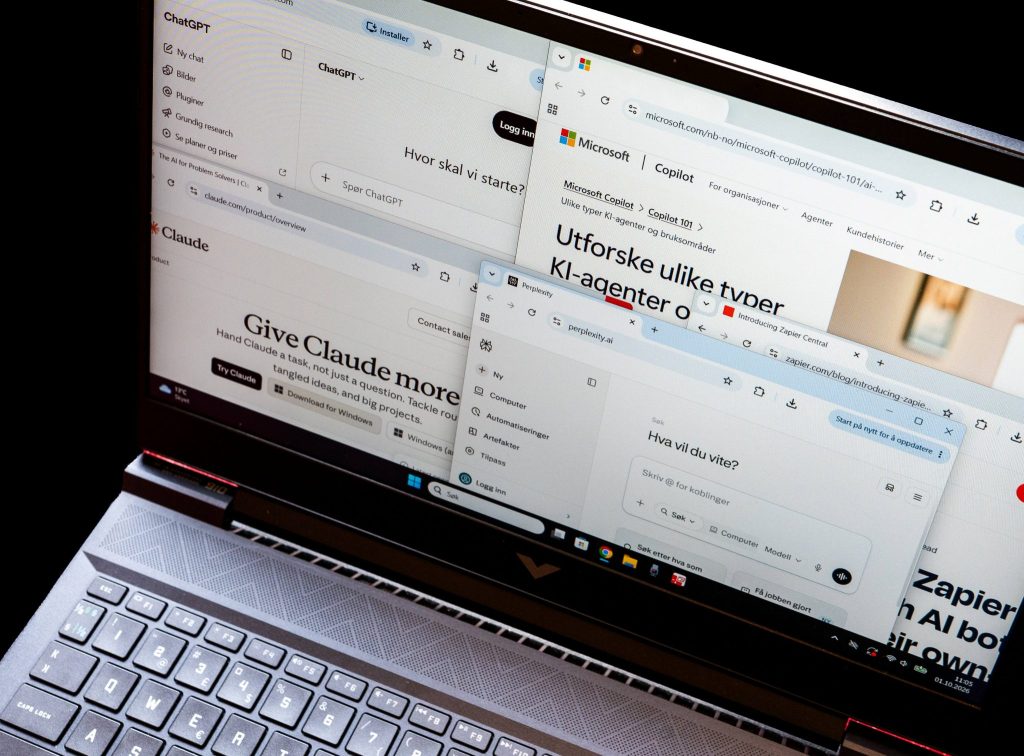
On 30 November 2022, the tech company OpenAI launched the ChatGPT chatbot, which uses artificial intelligence to create text, images, videos and more. It also communicates in the user’s own language.
Read the article in Norwegian on Arbeidsliv i Norden
It is a service that can think for itself, recognise patterns and find solutions to complex challenges, based on data it is being fed.
In one way, artificial intelligence is nothing new. The humble beginnings og this field of research can be traced back to 1956 and a group of researchers at Dartmouth College in the USA. But the launch of ChatGPT made AI a household name.
AI is more than chatbots, however. It is a group term for programs and technology that can mimic human intelligence.
As it becomes ever more widespread, many are starting to ask whether AI will change our working lives in dramatic ways, take over work itself or simply be a great resource.
Different types of AI
Lene Pettersen is someone who has studied the subject in depth. She is a professor in workplace studies at the University of Oslo.
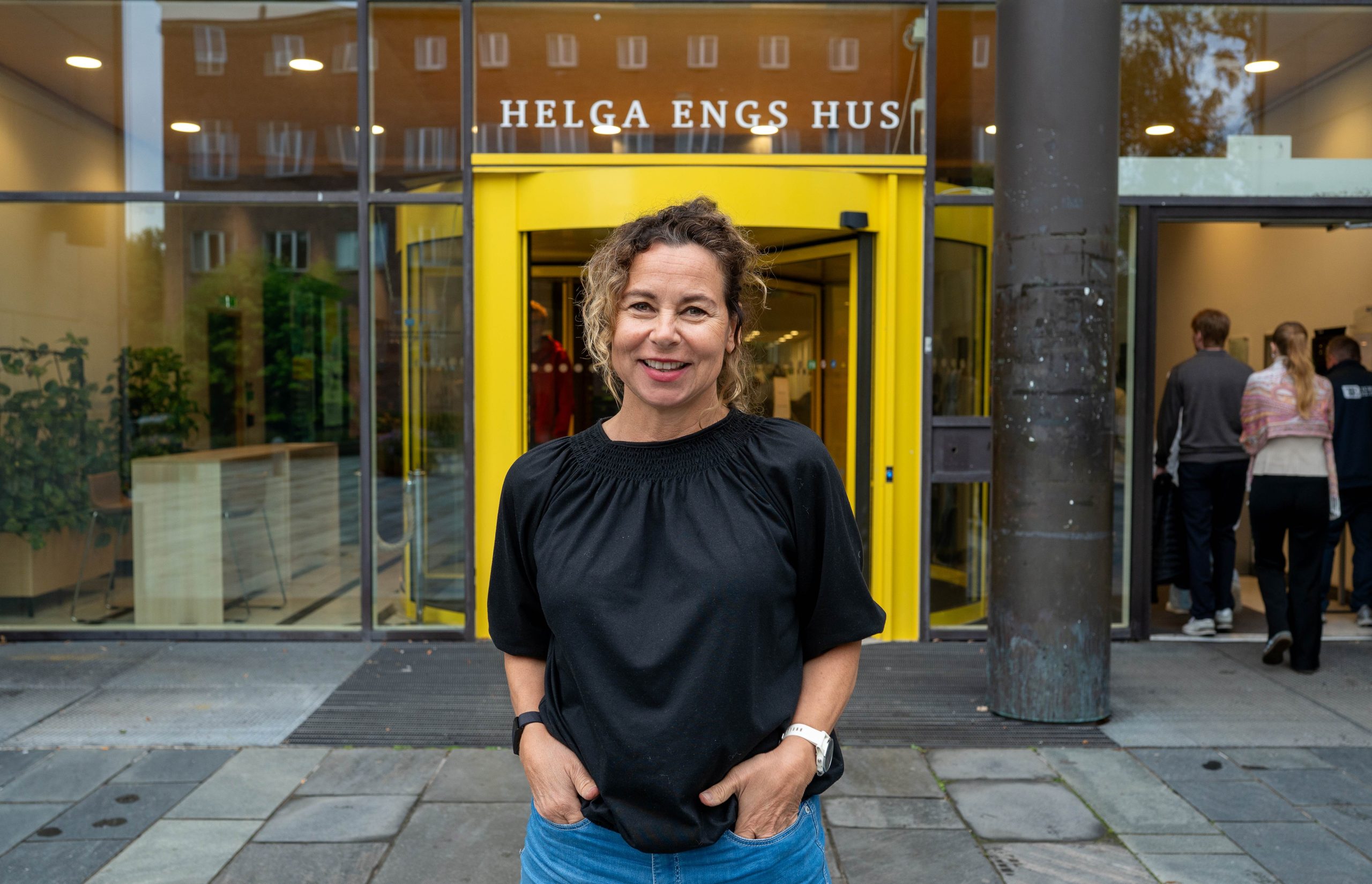
From her office in Helga Engs Hus, the social anthropologist spends a lot of her time researching and teaching about the triangle of people, work and technology.
Lene Pettersen
Professor of workplace studies at the University of Oslo
Does research on and teaches about the triangle people, work and technology
Affiliated to the KITE research group, which explores AI in working life and higher education
Pettersen is affiliated with the KITE research group that studies AI in working life and higher education, as well as the TRUST research centre – a national centre for artificial intelligence research.
“AI is far more than chatbots, but but chatbots are often what people associate with it. Today, we differentiate between different types of AI; chatbots (GenAI) is one of these, which can create content on its own.
“Another type of AI systems is those that can recognise patterns in large datasets and so on, often used to predict things.
“Then there are AI agents that you can instruct to perform various tasks largely on their own, for instance providing me with an overview over trends in a certain market every morning,” she says.
“This is the type that has attracted a great deal of attention recently, following reports of AI systems breaking out of their test environments and the ensuing debate about regulation, among other things.”
Community and education
Pettersen is interested in what digitalisation, digital technology and AI does to how we work. While AI presents us with both opportunities and challenges, the professor is worried about how chatbots can replace small but important conversations between colleagues.
“We need to talk with one another to learn from each other. Expertise and knowledge – learning – are things that are not developed in a vacuum, but collectively.
“When we work together, we learn from each other. That’s when the knowledge and skills that we take for granted emerge and help strengthen our professional communities.
“New employees are socialised into these communities and their fields of knowledge, and learn from more senior colleagues who might have many years of experience and a lot of expertise in a particular field.
“We need to trust each other in order to dare question issues and knowledge that we take for granted.
“Perhaps someone has suggestions for new ways of doing things? By asking obvious, perhaps ‘stupid’ questions about how we work or about a particular field, we make ourselves vulnerable, revealing things we may feel we ought to know.”
Pettersen also points out that by working together and getting to know each other, we develop a higher degree of trust in each other, and it is no longer scary to ask for advice or input from one another.
“Talking together means we get to know each other and build trust. Language helps create a shared foundation for our work community. By talking together we understand better what other people think.
“We also talk about other things by the coffee machine or before a meeting begins than what we say in an email, where we often have a particular reason to get in touch.
“Very rarely do we send emails to colleagues just to chat like we would if we met in the street: ‘Hi! How are you? Good weekend? What are you up to these days?’”
What about education, before you join working life? A very important part of education is personal growth and formation, to mature and reflect. If you leave many of the tasks you should have performed yourself to AI, and therefore fail to gain a proper understanding of the subject matter, might this limit maturity and professional competency?
“Those of us who work with education have an important job to do. There is a growing debate among us whether text is a dying art form when students ask technology to write the text for them. Is the master’s dissertation a dying breed? This is currently being discussed in academia.”
Pettersen says these challenges also provide an opportunity to rethink how we educate people and stimulate critical thinking. One of her courses includes a day’s workshop where students work together to dissect texts and evaluate them critically.
“The feedback from students is that they have not done a lot of critical thinking about research and scientific texts,” the professor says. She believes writing a scientific text should be one of the hallmarks of studying at university level.
She also believes we can explore new and innovative ways of approaching assessments and knowledge production.
Tradespeople and astronomers
Lene Pettersen says AI technology is something society and working life must relate to, for better or worse. One of the benefits is increased insight into different fields.
Such as risk assessment in the stock market?
“Yes, for instance. Or in scientific research which might help detect cancerous tumours more accurately.”
She also mentions the fact that many IT developers spend less time on coding, and that the costs of designing apps have become so low that anyone can make them now.
The professor believes many will be surprised to hear that AI is not only used in knowledge-based professions, but also in skilled trades including painting, plumbing and carpentry.
“When companies provide quotes to customers, they can use AI for instance to calculate how rooms should be painted, assess floor areas, create visual representations and estimate costs. It is also being used for 3D modelling and for how to best arrange rooms and optimise storage space.”
On the other hand, the potential for AI-driven efficiency improvements could transform job roles to such an extent that many will experience the changes to be negative and that work feels meaningless.
Pettersen quotes a study on astronomers done by a group of researchers at UCL in London.
“Researchers Durán del Fierro, Littlejohn and Kennedy found out that astronomers have moved from studying stars using telescopes and gather star data through fieldwork to sitting in front of computer screens interpreting data gathered by IT systems.
“Another similar example of how work risks becoming meaningless and changed through technology, is journalists who work quietly behind individual screens, office-bound journalists hunting for a trending story, rather than being out in the field.
“I find both examples somewhat sad.”
The fact that the joy of work disappears?
“Yes, and that your work can feel meaningless. This is important, because work gives meaning to our everyday lives.”
The spark, and time spent
Lene Pettersen says that she uses AI mainly to proofread her English, and that the actual text is something she will write herself in order to preserve what she calls “the Lene-spark” – her unique personal style, something nobody else can replicate.
“And do you really want to send off a text which clearly has been written by AI in generic language with no individual character? How does a text like that represent you?
“If we still use AI to write a text or presentation, don’t we have to spend time checking the content anyway? Do we really save that much time?
“These are things I have been thinking about a lot. It takes time, and what we’re actually doing is just moving from producing work to checking it. I find this striking.
“Just think about self-service checkouts where some guy is supervising rather than providing traditional customer service. And with AI-generated text, you have to check that the words actually make sense and that the information is accurate.”
The crystal ball
Will AI technology take our jobs or mainly change the tasks we perform?
“This has always been the question when new technology emerges, but technology cannot do everything that humans do. We have had vending machines for drinks and snacks for many years, but that doesn’t mean all kiosks have had to shut,” says Pettersen.
“Clearly, certain parts of occupations will change, and some will change completely, but this doesn’t necessarily mean that many jobs will become redundant.
“And even if tasks become more efficient, it doesn’t mean you yourself become redundant or get time off. You end up doing different tasks instead.”
Although AI technology offers unprecedented opportunities, with both positive and negative consequences, Pettersen still cautions against overstating its impact in the years ahead.
She thinks many are trying to gaze into a crystal ball to predict changes that in the end might not be as dramatic as you think.
“This is largely about the digitalisation of working life, and we have always had to adapt to new technology in the labour market, be it agricultural machines, the calculator or the typewriter.”